JEOPARDY
This resource outlines essential questioning strategies to improve student engagement and support higher-order thinking in the classroom. Drawing on concepts from Bloom's Taxonomy, this guide emphasizes the importance of question types, including divergent and convergent questioning, and the use of tools like question cubes and talk moves. It includes specific examples and practical applications for promoting thoughtful discourse among students. The focus is on encouraging students to generate their own questions, fostering deep understanding and evaluative thinking.


JEOPARDY
E N D
Presentation Transcript
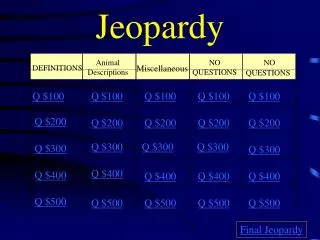
JEOPARDY Brainfriendly Potpourri H5 Blooming H2 I have so many QUESTIONS! H4 Strategies H1 Ciardiello, Not just breadsticks any more H3 Q $100 Q $100 Q $100 Q $100 Q $100 Q $200 Q $200 Q $200 Q $200 Q $200 Q $300 Q $300 Q $300 Q $300 Q $300 Q $400 Q $400 Q $400 Q $400 Q $400 Q $500 Q $500 Q $500 Q $500 Q $500 Final Jeopardy
$100 Question from H1 I’m six-sided and can help kids generate questions….. Return to Board
$100 Answer from H1 What are question cubes? Return to Board
$200 Question from H1 Right there, search, the author and me, on your own… Return to Board
$200 Answer from H1 What is the QAR strategy? Return to Board
$300 Question from H1 This “role” in literature circles would be an excellent way to apply questioning….. Return to Board
$300 Answer from H1 What is “questioner” or “discussion director? Return to Board
$400 Question from H1 These can be employed to encourage discourse with and between students….. Return to Board
$400 Answer from H1 What are “talk moves”? Return to Board
$500 Question from H1 Four of the twelve words that kids need to know come assessment time….. Return to Board
$500 Answer from H1 What are: Analyze, compare/contrast, describe, evaluate, explain, infer, formulate, predict, summarize, support, or trace Return to Board
$100 Question from H2 Justify how questioning addresses rigor. I “bloom” here…. Return to Board
$100 Answer from H2 What is evaluation? Return to Board
$200 Question from H2 The three of us do information processing…. Return to Board
$200 Answer from H2 What are analysis, synthesis, and evaluation? Return to Board
$300 Question from H2 You COULD “formulate” a question, based on this PD, from this level of Bloom’s taxonomy. (create a question) Return to Board
$300 Answer from H2 “_______________________.” Return to Board
$400 Question from H2 Personalize one way for students to show understanding of complex questions. Return to Board
$400 Answer from H2 “________________________________.” Return to Board
$500 Question from H2 In order for students to understand higher level questions, you will most likely do ____________ or ____________. (just fill in one of the blanks) Return to Board
$500 Answer from H2 What is “scaffold” or “be explicit”? Return to Board
$100 Question from H3 The easiest breadsticks to “digest”. Return to Board
$100 Answer from H3 What is memory? Return to Board
$200 Question from H3 At a Bloom’s grocery store, you’d find these breadsticks in the information processing section of your grocer’s freezer. Return to Board
$200 Answer from H3 What are divergent thinking and evaluative thinking? Return to Board
$300 Question from H3 The actual Stella Doro breakfast treats were in this shape. Return to Board
$300 Answer from H3 What is “S” shaped? Return to Board
$400 Question from H3 Identify two convergent thinking questions from the warm up activity. Return to Board
$400 Answer from H3 What are __________ and ___________? Return to Board
$500 Question from H3 This is an evaluative question an expert could ask about the three models of questioning shared today. Return to Board
$500 Answer from H3 ??????????????????????? Return to Board
$100 Question from H4 QUESTIONS is an acronym for…. Return to Board
$100 Answer from H4 Q uality U nderstanding E ncourage multiple responses S park new questions T hought-provoking I ndividualized O wnership shifted to students N arrow and broad S uccess building Return to Board
$200 Question from H4 Identify one similarity between Quality Questions and EQT. Return to Board
$200 Answer from H4 “_____________________________.” Return to Board
$300 Question from H4 This is how a question would sound coming from the lower right hand corner of the Questioning Matrix. Return to Board
$300 Answer from H4 What is “how could/would/should/n’t? Return to Board
$400 Question from H4 Construct a “why” question that would be 5/6 of the way to complex pertaining to this professional development session. Return to Board
$400 Answer from H4 What is “Why might/might not…..?” Return to Board
$500 Question from H4 Rigor and questioning should be applied to these three areas…. Return to Board
$500 Answer from H4 What is content, assessment, and instruction? Return to Board
$100 Question from H5 ____________-ended Return to Board
$100 Answer from H5 What is “open”? Return to Board
$200 Question from H5 “Good” or Brain-friendly questions do not do these two things…. Return to Board
$200 Answer from H5 Embarrass, generate fear, fail to provide instructional guidance, produce incorrect responses, or publically expose student’s lack of knowledge or skills Return to Board
$300 Question from H5 Brain-friendly questions usually ask what others think, they are….. Return to Board
$300 Answer from H5 What is deflective? Return to Board
$400 Question from H5 Using an EQT word or phrase, generate a question about this questioning/rigor session. Return to Board
$400 Answer from H5 • Might • Could • Be • What if • Someone else • Expert Return to Board