Maximizing p in the Function p = 10(30 + 5X - 0.4X²) - 2X - 18.1
This problem explores how to find the value of X that maximizes the function p = 10(30 + 5X - 0.4X²) - 2X - 18.1. By calculating the first-order condition (FOC), we set the derivative f'(X) to zero to solve for X, leading to X = 6. We then verify if this value satisfies the second-order condition (SOC) by evaluating the second derivative f''(X). Since f''(X) is -0.8, which is less than zero, we confirm that X = 6 is indeed a maximum.

Maximizing p in the Function p = 10(30 + 5X - 0.4X²) - 2X - 18.1
E N D
Presentation Transcript
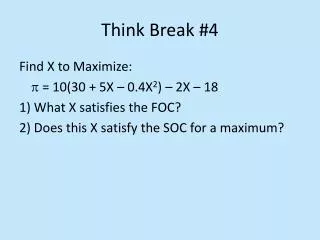
Think Break #4 Find X to Maximize: p = 10(30 + 5X – 0.4X2) – 2X – 18 1) What X satisfies the FOC? 2) Does this X satisfy the SOC for a maximum?
Think Break #4: Answer Find X to Maximize: p = 10(30 + 5X – 0.4X2) – 2X – 18 1) FOC f’(X) = 0, solve for X 10(5 – 0.8X) – 2 = 0 50 – 8X = 2 → 48 = 8X X = 6 2) SOC: f’’(X) < 0: f’’(X) = – 8 < 0 X = 6 is a maximum