Download
1 / 5
70 likes | 207 Vues
Explore the fascinating world of similar polygons through the investigation of rep-tiles. Learn how congruent shapes can combine to form larger, similar figures, and discover the essential concepts of scale factors, perimeter, and area in both triangles and quadrilaterals. This guide highlights the criteria for identifying similar shapes, focusing on angle measurements and scale relationships. By applying these principles, students will be able to understand and construct rep-tiled figures, enhancing their grasp of geometric similarities.

E N D
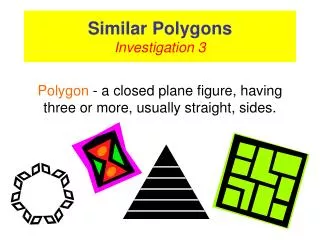
Similar PolygonsInvestigation 3 Polygon - a closed plane figure, having three or more, usually straight, sides.
3.1 Rep-Tile QuadrilateralsForming Rep–Tiles w/ Similar Quadrilaterals • If congruent copies of a shape can be put together to make a larger, similar shape, the original is called arep-tile.
3.2 Rep–Tile TrianglesForming Rep–Tiles w/ Similar Triangles Rep-Tiled Triangle Side 1 Side 2 Original Side 1 2 in 2 in 2 in Rep-Tiled Triangle Scale Factor= 2 because the side length is 2 times the original. Perimeter= 2 times the perimeter of the original. Area= 4 times the original area because 4 triangles fit into the rep-tiled triangle. Rep-Tiled Figure Area = (SF)2 times the original area
3.3 Scale Factors & Similar Shapes Two main Criteria for identifying similar figures: • Scale Factor • Angle Measurements Scale Factor 2 cm x 2 = 4 cm 3 cm x 2 = 6 cm Yes ABCD ~ EFGH Is ABCD~ EFGH? F G A B 2 cm D C 6 cm 3 cm E H 4 cm
3.3 Scale Factors & Similar Shapes Angle Measurements <A & < D = 65° <B & <E = 40° <C & <F = 75° Yes ΔABC ~ ΔDEF Is ΔABC ~ ΔDEF? A E D X 65° 75° 40° C B 75° 75° + 40° + X = 180° 115° + X = 180° 115° + 65° = 180° F Interior angles of a triangle = 180°