Download
1 / 5
50 likes | 150 Vues
Learn about the vulnerability in IPSec/IKE Public Key Encryption Aggressive Mode and how to address it effectively. Discover the Chess Grandmaster attack, prevention strategies, and the importance of message signatures. Enhance your understanding of the risks and solutions in securing your communication channels.

E N D
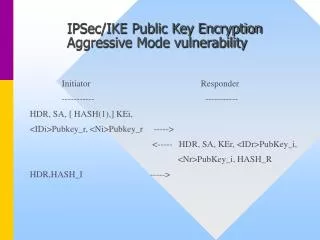
IPSec/IKE Public Key Encryption Aggressive Mode vulnerability Initiator Responder ----------- ----------- HDR, SA, [ HASH(1),] KEi, <IDi>Pubkey_r, <Ni>Pubkey_r -----> <----- HDR, SA, KEr, <IDr>PubKey_i, <Nr>PubKey_i, HASH_R HDR,HASH_I ----->
IPSec/IKE Public Key Encryption Aggressive Mode vulnerability • “Chess Grandmaster” attack
IPSec/IKE Public Key Encryption Aggressive Mode vulnerability Initiator Cheater Responder ----------- ----------- ----------- HDR, SA, KEi, <IDi>Pubkey_c, <Ni>Pubkey_c -----> HDR, SA, KEi, <IDc>Pubkey_r, <Ni>Pubkey_r -----> HDR, SA, KEr, <IDr>PubKey_c, <----- <Nr>PubKey_c, HASH_R HDR, SA, KEr, <IDc>Pubkey_i, <----- <Nr>Pubkey_i, HASH_C HDR,HASH_I -----> HDR, HASH_C ----->
IPSec/IKE Public Key Encryption Aggressive Mode vulnerability • HASH_x=prf(SKEIDxc,KEx|KEc|CKY-X|CKY-Y|IDxc) HASH_C=prf(SKEIDir, Kei|Ker|CKY-I|CKY-R|IDir) prf=HMAC or Keyed MAC KEx=g^DHPrivKey_x x=i, r SKEIDir=prf(HASH(Ni|Nr), CKY-I|CKY-R) • If Cheater isn’t agreed with any side, attack will be stopped in Phase 2 • If Cheater is agreed with Initiator(cheater knows DHPrivKey_i), they can fake Responder • Attack is possible in Main and Aggressive Mode
IPSec/IKE Public Key Encryption Aggressive Mode vulnerability • How to resolve problem? In protocol first and second message apply signature: 1. SIGNi(KEi) 2. SIGNr(KEr)