Download
1 / 56
560 likes | 669 Vues
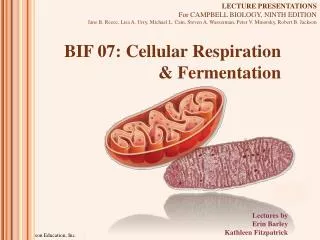
Cellular respiration is the process through which organisms convert food molecules into energy, specifically adenosine triphosphate (ATP). It involves gas exchange between an organism and its environment. The two main types of respiration are aerobic (which requires oxygen) and anaerobic (which does not). Aerobic respiration is more efficient, yielding 36 ATPs, while anaerobic respiration produces only 2 ATPs. Glycolysis, the first step of cellular respiration, occurs in the cytoplasm and breaks down glucose into usable energy. Understanding these processes is key to grasping how life sustains itself.

E N D
Respiration • The transfer of stored energy in food molecules to a form usable by the organism AND • involves the exchange of gases between the organism and the environment
Process • Through the process of respiration, the organism produces adenosine triphosphate (ATP) which is a used form of energy
Process (ADP + P) (ATP) Click on this link and be patient as it loads: From food to Fuel
1. Cellular Respiration • Involves a series of enzyme-controlled reactions in which _____ in _____ is broken down into energy that the organism can use _____.
Remember: Hydrolysis of ATP When ATP is broken down, energy is released and ADP is formed ____ + ____ ____ + ____ + ____ • This is the energy used by the body to carry out the functions of life • ADP = adenosine diphosphate
Do Now: • What words would you cluster together if you heard the words AEROBIC RESPIRATION? • And explain why? • ____ • ____ • ____ • ____
Glycolysis (splitting glucose) 2PGAL (C3H5O3) ________ (C6H12O6) +2 ATP 2 pyruvic acid ________ Net Gain:??? ________
Glycolysis (____ of ____ glucose) • Net Energy Yield from Glycolysis +___ ATP • Energy requiring steps: • 2 ATP invested • Energy releasing steps: • 2 NADH formed • 4 ATP formed • Net yield is 2 ATP and 2 NADH
Glycolysis (splitting glucose) All three reactions with Glycolysis • Glycolysis occurs in cytoplasm • Reactions are catalyzed by enzymes Glucose 2 Pyruvate (six carbons) (three carbons)
Types of Respiration • __________________ -involves the use of oxygen 2. __________________ -oxygen is not used
Respiration Respiration • Respiration- is an organisms’ ability to create energy. (ATP) _______________ Respiration _______________ Respiration _________ Fermentation _________ Fermentation
Anaerobic Respiration • Also known as _________ • Does not require _________ • Takes place in the _________ of cell • Glucose is either broken down into _________ or _____ and _____ • As a result of anaerobic respiration, there is a net gain of _____ ATP’s
The TWO Equations for Anaerobic Respiration lactic acid Fermentation ______ 2 ____ ____ + __ ____ ______ 2 _______ + 2 ___ + __ ATP’s • In each equation, enzymes are used and a net gain of 2 ATP’s are produced Alcohol fermentation
Lactic Acid Fermentation 2 ATP 2 pyruvic acid Lactic Acid _______ 4 ATP “Lactic Acid Fermentation
Lactic Acid Fermentation 1. 2. 3. 4. 5. .
Alcoholic Fermentation 2 ATP 2 Pyruvic acid ________ Alcohol + CO2 4 ATP “Alcoholic Fermentation”
Alcoholic Fermentation 1. 2. 3. 4.
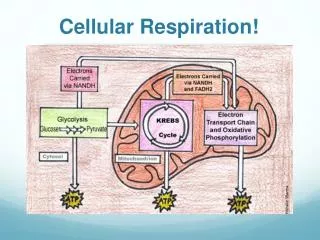
Label the picture below:Cellular Respiration: Mitochondrion Cytoplasm Electrons carried in NADH Pyruvic acid Electrons carried in NADH and FADH2 4. _______ _______ _____ 3._________ 2.__________ 1._________
Aerobic Respiration • Requires _________ • Takes place in the __________ • When we say that glucose is_______, we say that it is _______ down with the help of oxygen molecules
Aerobic Respiration • 3 Steps/Stages
Do Now:What does this box represent? _________What reaction is taking place? _________ • Does this happen in plants, animals or both?
Equation for Aerobic Respiration _______ + ____ H2O + ____ + ____ ATP’s • Again, enzymes are used and a net of _____ ATP’s are produced
Aerobic Respiration 2 ATP 2 Pyruvic acid ___ Water + ____ + ________ +4 ATP +34 ATP ***Net Gain = ___ATPs***
Aerobic Respiration 1. 2. 3. 4. 5 What else can you tell me about it?
Do Now: What is the relationship between photosynthesis and aerobic respiration?
Video 1 Video 1 • Click the image to play the video segment. Aerobic Respiration
Video 2 Video 2 • Click the image to play the video segment. Glycolysis
Video 3 Video 3 • Click the image to play the video segment. Krebs Cycle, Part 1
Summary • Anaerobic Respiration = 2 ATP’s • Aerobic Respiration = 36 ATP’s • Therefore, Aerobic respiration is more efficient than anaerobic respiration
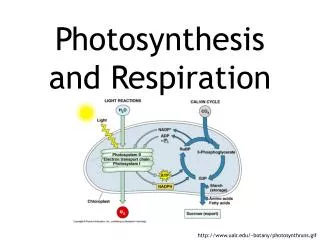
Aerobic Respiration and Photosynthesis http://www.dnr.state.wi.us/org/water/fhp/lakes/under/oxygen.htm
Are the lights that hang over this lab setup on or off? Carbon Dioxide Output vs. Time
Adaptations for Respiration
Monera, Protista, and Fungi • Gas exchange occurs by diffusion through a thin, moist cell membrane
Plants • Leaves- have stomates for gas exchange • Stems- have lenticels for gas exchange • Roots- gas exchange occurs across a moist membrane of root hairs (diffusion)
Hydra • Each cell of the hydra is in contact with the watery environment and gas exchange occurs by diffusion
Earthworm • Double Diffusion • Skin • Circulatory System • Requires moist skin • The earthworm absorbs oxygen and gives off carbon dioxide through a thin skin. • This skin is protected by a thin cuticle secreted by the epidermis and kept moist by a slimy mucus also produced by epidermal cells.
Grasshopper • Uses Tracheal Tubes • Air Sacs • Spiracles
TO RESPIRE:inhaling and exhaling… • Inhalation = O2 (oxygen) enters the body system • Exhalation =CO2 (carbon dioxide) is passed out of the body
Your Respiratory System Nose (nasal cavity) Pharynx Larynx Trachea Bronchi Bronchioles alveoli pleura diaphragm
Synthesis You’re doing A fine job dear….
Your Metabolism has two major phases. • Catabolism-the breaking down of complex substances. • The destructive phase of your metabolism AKA: • Anabolism- the building of new substances. AKA- Synthesis (Digestion or Hydrolysis)
Synthesis • A process by which simple substances are combined “chemically” to form more complex substances. • These materials are used for growth and repair of the organism.
The Borg Ingestion Digestion Transport Synthesis Growth
Cells synthesize (or makes) • their own proteins, fats, polysaccharides, and nucleic acids. • use enzymes and energy to synthesize proteins, as do you…. • Cells must constantly make new materials forgrowthand repair.