Download
1 / 7
80 likes | 209 Vues
This guide explains how to identify and work with similar figures in geometry. Similar figures have the same shape but may differ in size, which allows us to use proportions to determine missing side lengths. The notation ∼ indicates similarity between figures, such as triangles. This resource covers key concepts, including proportional relationships between corresponding sides, the importance of letter order, and techniques for solving problems using cross-products. Practice problems are included to enhance understanding and application of these concepts in indirect measurements.

E N D
4.5Similar Figures I can use proportions to find missing lengths in similar figures.
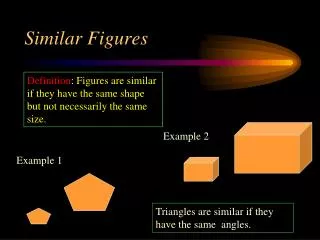
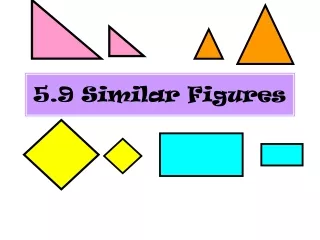
Similar Figures • Same shape, but not necessarily same size • You can use proportions to find missing side lengths of similar figures. • The symbol ∼ means “is similar to”
Example • ∆ABC ∼ ∆FGH • This means the triangles are similar. • In similar figures, corresponding angles are equal, and corresponding side lengths are proportional. • The order of the letters when making similar figures is important
Practice • If ∆ABC ∼ ∆DEF, what is the length of side DE? • Set up a proportion • Cross product • 10(12) = 16(DE) • 7.5 = DE
You Try! • Using the same figure, find AC
Indirect Measurement • Use proportions to find measurement that you cannot find by measuring directly. • Create a proportion • x=25 feet
Assignment • ODDS ONLY • P.153 #7-19