Exploring Plato's "The Republic": Philosophy, Governance, and The Allegory of the Cave
In "The Republic," Plato grapples with the tragic fate of Socrates, exploring the nature of justice and governance. Although the title translates as “affairs of the State,” the work critically evaluates political systems, ultimately favoring a timarchy, as seen in Sparta, over democracy— which led to Socrates' execution. Plato introduces the concept of philosopher-kings, educated from birth in the art of governance, as ideal rulers. The famous Allegory of the Cave emphasizes that mere observation is insufficient; true understanding stems from knowledge and interpretation of the world around us.

Exploring Plato's "The Republic": Philosophy, Governance, and The Allegory of the Cave
E N D
Presentation Transcript
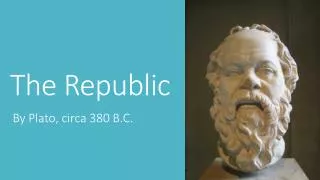
1. The Republic This was an attempt by Plato to understand the tragedy of Socrates. Republic is not the best translation of the book. It means something nearer to “affairs of the State” meaning the polis or city states of Greece.
It is about how to govern a city state and came to the conclusion that a timarchy ( rule by property owners or the honourable) as was practised in Sparta was the best available way. Democracy was not considered by Plato to be the best form of Government. It was democracy that executed the man he admires most Socrates.
He puts forward the idea that the best rule is by philosopher kings, men specially trained from birth in the art of government.
The allegory of “The Cave” is found in The Republic. In this Plato believes that seeing is not enough; one must have knowledge as well in order to interpret what one sees.