
Chinese Dynasties: Rulers, Religion, and Culture
E N D
Presentation Transcript
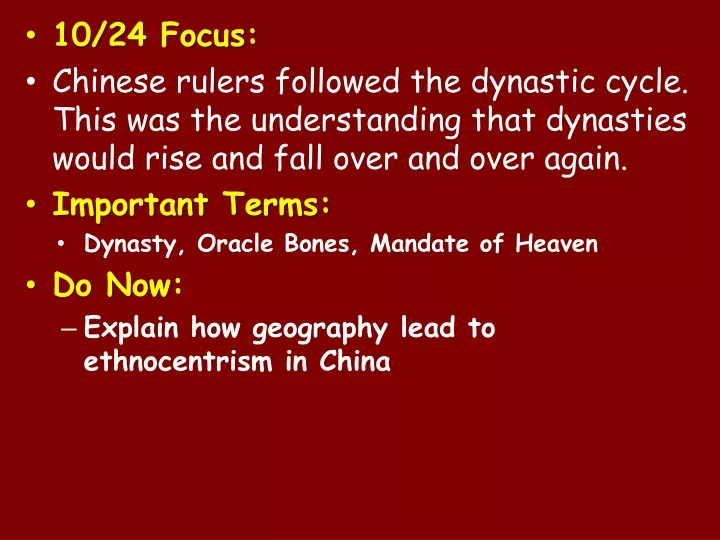
10/24 Focus: • Chinese rulers followed the dynastic cycle. This was the understanding that dynasties would rise and fall over and over again. • Important Terms: • Dynasty, Oracle Bones, Mandate of Heaven • Do Now: • Explain how geography lead to ethnocentrism in China
China Dynasties
The Shang Dynasty 1650 B.C. Shang gain control of N. China Government Ruled by Kings Establish first dynasty A ruling family
The Shang Dynasty • Religion • Polytheistic • Worshiped ancestors • oracle bones • Used to communicate with ancestors • Bones inscribed with pictographs • Priests could read them for messages from ancestors • Offered ancestors gifts for the afterlife
The Shang Dynasty • written language • used pictograms • symbols that represent pictures • Ideograms • symbols that represent ideas. • used on the Oracle Bones, but only few people learned how to read and write
The Zhou Dynasty • 1029 -258 B.C. • Overthrow the Shang • Told people that the gods had become angry with Shang corruption & had chosen the Zhou to rule • Leads to the Mandate of Heaven King Wen, The founder of the Zhou dynasty
The Mandate of Heaven • divine approval to rule • Used by rulers to claim authority over people • Was used to explain the dynastic cycle • New dynasties were good and just to the people • Overtime the dynasty became corrupt and unfair to the people • Lost approval of gods • New dynasty would take over
Closure • How was the Mandate of Heaven used to justify the overthrow of a government? • What was the dynastic cycle?
10/27 Focus: • The Great Wall of China was created during the Qin Dynasty and is an example of Chinese ethnocentrism. • The Han Dynasty built a large civilization by using roads. They expanded trade routes and made a great deal of money that helped them expand. • Do Now: • Explain the Mandate of Heaven
Zhou Government • Zhou kings called themselves “Sons of Heaven • Kings granted large areas of land to their supporters • Feudalism • Local lords controlled their own land • Owed military service to the ruler • Feudal lords became the real holders of power in China
Zhou Accomplishments • Built roads and canals to expand trade • Silk production • Produced from cocoons of silkworms • Became a major export • Made the first books • Bound thin strips of bamboo & wood • The I Ching • Book of Songs • Astronomy • Developed an accurate calendar • Studied eclipses and movement of planets
Qin Dynasty • Shi Huangdi • “The First Emperor” • Conquers the Zhou • Zhou government was weak • Feudal lords divided and at war
Centralized Power • Shi Huangdi centralizes power and establishes autocracy • Power from one central area • Autocracy • A government in which the ruler has absolute or total power • Abolishes the feudal states • Divided the country into military districts • Harsh rules • Rules about being on time • Forced labor to build public works • High taxes
The Great Wall of China • Extended from the Yellow Sea to the Gobi Desert • Forced labor used to construct the wall • Ethnocentrism • Built to keep out nomads and invaders • Keep out foreign influences • Limits cultural diffusion
The famous Terracotta Soldiers were built to guard the Emperor’ s tomb
The Han Dynasty • Shi Huangdi dies • People revolt against the Qin • Liu Bang established the Han dyansty • Peasant leader • Takes the name Gau Zu • Reduced taxes • Changed harsh Qin laws
Han Rule • Emperor Wudi • 441 B.C • Strengthens China’s government and economy • Establishes civil service system • Government workers • Civil service exam was required to work in government • Based on teachings of Confucius • Opened the Silk Road
The Silk Road • Becomes a major trade route • Stretches from China to Mediterranean Sea • Brings China in contact with other civilizations • Cultural diffusion • Buddhism from India • New ideas, foods, animals , and products are spread along the silk road
Han Golden Age • Expansion of trade and strong government under Han rule brought peace and prosperity • Technological Advances • Made paper from wood pulp • Iron production • Water powered mills • Invented: • Wheelbarrow • Fishing reel • Rudder
Han Golden Age • Advances in Science and Medicine • Acupuncture and herbal remedies to treat illness • Develop anesthesia • Advanced astronomers • Developed accurate clocks
Han Decline • Power shifted from strong central gov’t to local nobles • Nomadic groups began invading China • Led to 350 years of warfare and chaos • Period of Disunion (220-589 C.E.)
Closure • How is the construction of the Great Wall of China an example of Chinese ethnocentrism? • Why did the Silk Road increase cultural diffusion?