Download
1 / 18
180 likes | 284 Vues
In this lecture from UC Berkeley's CS10 course "The Beauty and Joy of Computing," lecturer Dan Garcia discusses the fundamentals of algorithmic complexity. He explains the importance of measuring running time, efficiency, and the concepts of worst-case versus average-case scenarios. The session highlights the significance of functional abstraction, algorithm correctness, and the criteria for selecting algorithms based on inputs and outputs. This lecture serves as foundational knowledge for students delving into computer science and algorithm analysis, preparing them for challenges in the field.

E N D
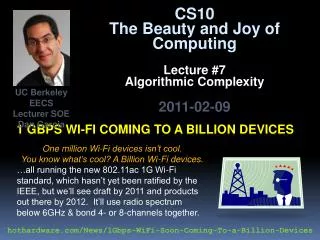
CS10The Beauty and Joy of ComputingLecture #7Algorithmic Complexity 2011-02-09 UC Berkeley EECSLecturer SOEDan Garcia One million Wi-Fi devices isn’t cool. You know what’s cool? A Billion Wi-Fi devices. …all running the new 802.11ac 1G Wi-Fi standard, which hasn’t yet been ratified by the IEEE, but we’ll see draft by 2011 and products out there by 2012. It’ll use radio spectrum below 6GHz & bond 4- or 8-channels together. 1 Gbpswi-fi coming to a billion devices hothardware.com/News/1Gbps-WiFi-Soon-Coming-To-a-Billion-Devices
Functional Abstraction (review) • A block, or function has inputs & outputs • Possibly no inputs • Possibly no outputs (if block is a command) • In this case, it would have a “side effect”, i.e., what it does (e.g., move a robot) • The contract describing what that block does is called a specification or spec F x F(x)
What is IN a spec? (review) • Typically they all have • NAME • INPUT(s) • (and types, if appropriate) • Requirements • OUTPUT • Can write “none” • (SIDE-EFFECTS) • EXAMPLE CALLS • Example • NAME :Double • INPUT :n (a number) • OUTPUT:n + n Double n Double(n)
What is NOT in a spec? • How! • That’s the beauty of a functional abstraction; it doesn’t say how it will do its job. • Example: Double • Could be n * 2 • Could be n + n • Could be n+1 (n times) • if n is a positive integer • This gives great freedom to author! • You choose Algorithm(s)!
UC Berkeley CS10 "The Beauty and Joy of Computing" : Algorithm Complexity What do YOU think? Which factor below is the most important in choosing the algorithm to use? • Simplest? • Easiest to implement? • Takes less time? • Uses up less space (memory)? • Gives a more precise answer?
Reference text • This book launched a generation of CS students into Algorithm Analysis • It’s on everyone’s shelf • It might be hard to grok at this point, but if you go on in CS, remember it & own it! • …but get the most recent vers
Algorithm analysis : the basics • An algorithm is correct if, for every input, it reports the correct output and doesn’t run forever or cause an error. • Incorrect algorithms may run forever, or may crash, or may not return the correct answer. • They could still be useful! • Consider an approximation… • For now, we’ll only consider correct algorithms Algorithm for managing Vitamin D sterols based on serum calcium levels. www.kidney.org/professionals/kdoqi/guidelines_bone/guide8b.htm
UC Berkeley CS10 "The Beauty and Joy of Computing" : Algorithm Complexity Algorithm analysis : running time • One commonly used criterion in making a decision is running time • how long does the algorithm take to run and finish its task? • How do we measure it? 08:23:12
UC Berkeley CS10 "The Beauty and Joy of Computing" : Algorithm Complexity Runtime analysis problem & solution • Time w/stopwatch, but… • Different computers may have different runtimes. • Same computer may have different runtime on the same input. • Need to implement the algorithm first to run it. • Solution: Count the number of “steps” involved, not time! • Each operation = 1 step • If we say “running time”, we’ll mean # of steps, not time!
UC Berkeley CS10 "The Beauty and Joy of Computing" : Algorithm Complexity Runtime analysis : input size & efficiency • Definition • Input size: the # of things in the input. • E.g., # of things in a list • Running time as a function of input size • Measures efficiency • Important! • In CS10 we won’t care about the efficiency of your solutions! • …in CS61B we will
UC Berkeley CS10 "The Beauty and Joy of Computing" : Algorithm Complexity Runtime analysis : worst or avg case? • Could use avg case • Average running time over a vast # of inputs • Instead: use worst case • Consider running time as input grows • Why? • Nice to know most time we’d ever spend • Worst case happens often • Avg is often ~ worst
Runtime analysis: Final abstraction • Instead of an exact number of operations we’ll use abstraction • Want order of growth, or dominant term • In CS10 we’ll consider • Constant • Logarithmic • Linear • Quadratic • Cubic • Exponential • E.g. 10 n2 + 4 log n + n • …is quadratic Exponential Cubic Quadratic Linear Logarithmic Constant Graph of order of growth curves on log-log plot
Example: Finding a student (by ID) • Input • Unsorted list of students L • Particular student S • Output • True if S is in L, else False • Pseudocode Algorithm • Start one by one, checking for match. • If match, true • If exhausted L and didn’t find S, false • Worst-case running time as function of the size of L? • Constant • Logarithmic • Linear • Quadratic • Exponential
Example: Finding a student (by ID) • Input • Sortedlist of students L • Particular student S • Output : same • Pseudocode Algorithm • Start in middle • If match, report true • If exhausted, throw away half of L and check again in the middle of remaining part of L • If nobody left, report false • Worst-case running time as function of the size of L? • Constant • Logarithmic • Linear • Quadratic • Exponential
Example: Finding a student (by ID) • What if L were given to you in advance and you had infinite storage? • Could you do any better than logarithmic? • Worst-case running time as function of the size of L? • Constant • Logarithmic • Linear • Quadratic • Exponential
Example: Finding a shared birthday • Input • Unsorted list L (of size n) of birthdays of team • Output • True if any two people shared birthday, else False • What’s the worst-case running time? • Worst-case running time as function of the size of L? • Constant • Logarithmic • Linear • Quadratic • Exponential
Example: Finding subsets • Input: • Unsorted list L (of size n) of people • Output • All the subsets • Worst-case running time? • E.g., for 3 people (a,b,c): • 1 empty: { } • 3 1-person: {a, b, c} • 3 2-person: {ab, bc, ac} • 1 3-person: {abc} • Worst-case running time as function of the size of L? • Constant • Logarithmic • Linear • Quadratic • Exponential
Summary • When choosing algorithm, could optimize for • Simplest • Easiest to implement? • Most efficient • Uses up least resources • Gives most precision • … • In CS10 we’ll consider • Constant • Logarithmic • Linear • Quadratic • Cubic • Exponential How does the goalie choose how to block ball?