Understanding Sequences: Arithmetic and Geometric Progressions Explained
This guide provides a comprehensive overview of sequences, focusing on arithmetic and geometric progressions. A sequence is an arrangement of numbers following specific rules, illustrated with examples. Arithmetic progressions feature a constant difference between ordered terms, while geometric progressions maintain a constant ratio. The document includes formulas to calculate specific terms, differences, and center terms in both types of progressions, alongside practical examples for clarity. Perfect for students and learners seeking to understand basic concepts in mathematics.


Understanding Sequences: Arithmetic and Geometric Progressions Explained
E N D
Presentation Transcript
1 5 4 3 2
10 7 1 SEQUENCES 9 2 3 4 6 5 8 • BY: • CAHYO HENY MEILIANA K1310019 • NABILLAH K1310000
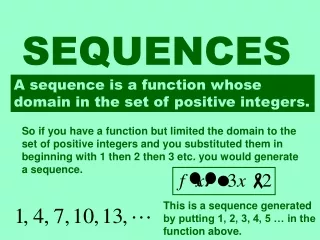
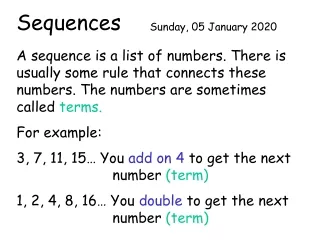
DEFINITION • Sequence is arrangement of number which has certain rules. • Examples : • 2, 4, 6, 8, 10, 12, 14, …. • 2, 4, 8, 16, 32, 64, 128,…. • 9, 3, 1/3, 1/9, 1/27, ….
1. Arithmetic progressions • Arithmetic progressions is sequence of numbers which has difference between two of ordered terms and always constant.Examples: • 1, 3, 5, 7, 9, … . • the difference is 2 • 10, 8, 6, 4, 2,… . • the difference is -2
Generally, we can write : • U1’ U2, U3, U4,…. Un • If U1= a and difference between ordered terms = b, so that • a, a + b, a + 2b, a + 3b, a + 4b, …. . a + ( n – 1 ) b
If first terms called a and difference of ordered term is called b, so: • U 1 ,U2 , U3 , U4, …, Un-2 , Un-1 , Un a, a+b, a+2b, a+3b,… , a+(n-3)b, a+(n-2)b, a+(n-1)b
Term of - n • Un = a + ( n – 1 ) b Un = Term of – n a = first term b = difference of ordered term n = total of term
Example: • Given Arithmetic progression 3, 9, 15, 21, ……Find term of 20 Solution: U20 = a + ( n – 1 ) b = 3 + ( 20 – 1 ) 6 = 3 + 19. 6 = 3 + 114 = 117
The center term • U1, U2, U3 the center term is U2 U2 = a + b = ½ ( 2a + 2b ) = ½ ( a + a + 2b ) = ½ ( U1 + U3 ) 2. U1, U2, U3, U4, U5 • the center term is U3 U2 = a + 2b = ½ ( 2a + 4b ) = ½ ( a + a + 4b ) = ½ ( U1 + U5)
etc… • U1, U2, U3, U4, U5 …. . Un. • Uc= ½ ( U1 + Un) • with n = odd
Interpolated • If given 2 of numbers x and y will be interpolated a number of k so that formed arithmetic progression: x, x + bi, x + 2bi, x + 3bi, ….. x + kbi, y the difference of interpolated is bi= y – ( x + kbi) bi+ kbi= y – x bi = ( y – x )/(1 + k) bi = difference of interpolated y = second number x = first number k = total of interpolated
Example: • Between 7 and 107 be interpolated 19 of numbers so that formed arithmetic progression. • Find: 1. difference of sequence that formed 2. Term of 10 3. The center term if exist
Solution: 1. Difference of sequence Given x = 7 and y = 107 bs = ( y – x )/(k + 1) = (107 – 7 )/(19+1) = ( 100 ) / 20 = 100/20 = 5 2. Term of 10 U10= a + ( n – 1 ) bs = 7 + ( 10 – 1 ) 5 = 7 + 9.5 = 7 + 45 = 52 3. Un = 107 107 = 7 + ( n – 1 ) 5 100 = 5n – 5 105 = 5n n = 105 / 5 n = 21 Hence, Uc= ½ ( U1 + U21 ) = ½ ( 7 + 107 ) = ½ ( 114 ) = 57 Thus, the center term is 57
Geometric Progression • Definition • Geometric Progression is sequence of number which has constant ratio . • U1, U2, U3, U4, U5, … Un
U1, U2, U3, U4, U5, … Un • IfU1 = a U1= a • U2= ar • U3= ar2 • U4= ar3 • …. • Un= arn-1 Example: Given a sequence 2, 4, 8, … Find U7 ! Solution : U7= ar7-1 U7 = 2.26 U7 = 2. 64 U7 = 128
The center term • The center term of geometric progression can be wrote such as: • U1, U2, U3,so that he center term is U2 • U2 =
Similarly, • U1, U2, U3, U4, … Uk • if k is odd so that the center term is • Uc= • where k = odd • Uc= the center term • Uk= the term of k ( end )
Example: From term of geometric progression given U2=4 and U10=1024, then find five of sequence first term! Solution: U2 =a r2-1= a r =4 …………………………. 1) U10= a r 10-1 = a r 9 =1024 ……………... 2) From equation 1) , we obtain: a = 4/r ……………3)
Substitute equation 3) to equation 2) and we have, • (4/r).r9 =1024 • 4r8 =1024 • r 8 =256 • r =2 • then substitute value of r =2 to equation 3) to get value of a = 2. • Thus, five of geometric progression first term is 2, 4, 8, 16, 32.