Understanding Simple Machines: Types, Functions, and Efficiencies
This resource explores simple machines, their definitions, and how they make work easier by altering force amounts or directions. Learn about various types of simple machines, including inclined planes, screws, wedges, levers, wheel and axles, and pulleys. Understand mechanical advantage, efficiency, and how these concepts apply to everyday tools. Gain insights into compound machines that combine simple machines, maximizing functionality for various tasks. Discover the practical applications and benefits of these machines in our daily lives.

Understanding Simple Machines: Types, Functions, and Efficiencies
E N D
Presentation Transcript
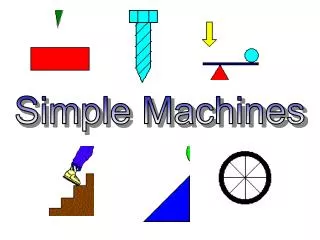
Definition of a Simple Machine • Makes work easier by changing either • The amount of the force needed • Or the direction of the force
Inclined Planes • An inclined plane is a flat surface that is higher on one end • Inclined planes make the work of moving things easier
MECHANICAL ADVANTAGE • Is a measure of the “goodness” of a machine • The higher the MA the better? • What force acts/work against MA? • EFFICIENCY: less friction = greater Efficiency
length height l h length of ramp height of ramp Inclined Plane • Sloped surface used to make lifting easier • MA =
Screws • A screw is an inclined plane wrapped around a shaft or cylinder. • The inclined plane allows the screw to move itself when rotated.
Don’t measure the top! gap twice the radius of rod radius of rod 2 rr lg length of gap Note: 2 r = d The Screw • A screw is an inclined plane wrapped around a rod • Use to hold objects together • MA =
Wedges • Two inclined planes joined back to back. • Wedges are used to split things.
width height h w height of wedge width of wedge Wedge • A wedge is an inclined plane with two sloping surfaces • Used to cut • MA =
Wheels and Axles • The wheel and axle are a simple machine • The axle is a rod that goes through the wheel which allows the wheel to turn • Gears are a form of wheels and axles
Pulleys • Pulley are wheels with a groove around the outside • A pulley needs a rope, chain or belt around the groove to make it do work
Three Types of Levers • All levers have a fulcrum
Levers-First Class • In a first class lever the fulcrum is in the middle and the load and effort is on either side • Think of a see-saw
Levers-Second Class • In a second class lever the fulcrum is at the end, with the load in the middle • Think of a wheelbarrow
Levers-Third Class • In a third class lever the fulcrum is again at the end, but the effort is in the middle • Think of a pair of tweezers
Levers • A lever is a bar that is free to move about a pivot point • A lever has three parts • effort arm • fulcrum • resistance arm resistance arm effort arm fulcrum
Second Class First Class Third Class Types of Levers • Levers are grouped into three classes
First Class Lever • Fulcrum in the middle of the bar • Examples • Balance • Paint can • Teeter-totter resistance force effort force
Second Class Lever • Resistance force (load) is in the middle • Examples • wheel barrow • door • nut cracker resistance force effort force
Third Class Lever • Effort force is in the middle • Examples • baseball bat • fishing pole • canoe paddle • broom resistance force effort force
length of effort arm le lr length of resistance arm resistance arm effort arm Mechanical Advantage of Levers • MA =
Wheel and Axle smaller wheel • Two wheels of different sizes • Connected and move together • Examples • door knob • pencil sharpener • screw driver larger wheel
Large force out small force in Wheel and Axle • A wheel and axle act like a circular lever. • By turning the large blue wheel, • The smaller yellow axle also turns.
Large distance out Small distance in Wheel and Axle • Or, the two can be used in reverse. • By turning the small yellow axle • The larger blue wheel also moves.
radius of wheel rw ra wheel axle radius of axle MA of Wheel and Axle • MA =
Pulleys • A pulley is a surface with a chain or rope going around • Used to lift heavy objects • Two types • Fixed • movable
Types of Pulleys fixed pulley • Fixed Pulley • Pulley is fastened into position • Changes the direction of force • Does not magnify the force
Types of Pulleys • Movable Pulley • Pulley is fastened to the load • Load is shared between both ends of the line • Only half the force is needed to lift the load movable pulley
MA = 1 One line is supporting the load. MA = 2 Two lines are supporting the load. MA of a Pulley • MA = number of lines supporting the load • Don’t count the line that is being pulled.
Efficiency •Efficiency is the ability to convert input work into actual work output. • no machine is perfect • loss caused by friction
Output Work WO WI • Efficiency = 100 Input Work Calculating Efficiency • Ideal machines have 100% efficiency.
Compound Machines • A compound machine is a combination of simple machines that work together.
Simple Machines • Simple Machines can be put together in different ways to make complex machines • A complex machine is one or more simple machines