Flutter vs React Native: Which Cross-Platform Framework is Right for You?
As Mobile App Development continues to evolve, the competition between Flutter and React Native is heating up. In this blog post, weu2019ll be taking an in-depth look at Flutter vs React Native exploring their pros, cons, and everything you need to know before making your choice! So buckle up and get ready to explore the world of cross-platform mobile app development like never before!

Flutter vs React Native: Which Cross-Platform Framework is Right for You?
E N D
Presentation Transcript
Flutter vs React Native: Which Cross-Platform Framework is Right for You? As Mobile App Development continues to evolve, the competition between Flutter and React Native is heating up. These two frameworks have taken the world by storm with their amazing capabilities and unique features that make them stand out from each other. With 2023 just around the corner, it’s time for developers to take a closer look at these powerful tools and decide which will reign supreme in the years ahead. In this blog post, we’ll be taking an in-depth look at Flutter vs React Native – exploring their pros, cons, and everything you need to know before making your choice! So buckle up and get ready to explore the world of cross-platform mobile app development like never before! What is React Native? React Native is an open-source framework developed by Facebook that allows developers to build mobile apps using JavaScript and a set of pre-built UI components. With React Native, developers can build apps for both iOS and Android using a single codebase. React Native allows for fast and efficient development, high performance, and a rich user experience. What is Flutter? Flutter is an open-source framework developed by Google that allows developers to build mobile, web, and desktop apps using the Dart programming language. Flutter provides a rich set of customizable UI components, known as widgets, that allow for a highly customized and responsive user interface. Flutter also offers hot reload, which allows for a faster development process, and high performance due to its native compilation to machine code. Flutter vs React Native – Comparison
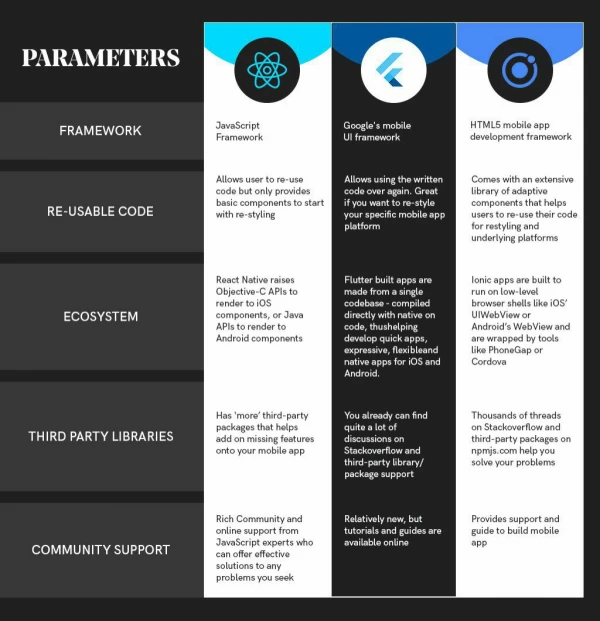
Language: Flutter uses Dart, a modern object-oriented language developed by Google. React Native, on the other hand, uses JavaScript, a widely used programming language known for its versatility. UI Components: Flutter provides a rich set of customizable UI components, known as widgets, that developers can use to build their apps from scratch. React Native provides pre-built components that can be easily customized using CSS-like styling. Performance: Flutter’s architecture allows it to compile to native code, resulting in high-performance apps. React Native communicates directly with native modules, resulting in better performance than other hybrid app development frameworks, but not as good as Flutter. READ MORE