Future Developments and Upgrades in FTLRS Calibration and Validation Projects
This paper discusses the collaborative efforts between the University of Tasmania and the Observatoire de la Côte d'Azur on the calibration and validation of the Jason-1 satellite. It highlights a five-month scientific program in Burnie, Tasmania, which serves as the only calibration site in the Southern Hemisphere. The roles of both institutions are described, including technological contributions and funding. The document also addresses the implementation of real-time systems and the upgrades undertaken in summer 2008, specifically focusing on timing systems critical for engineering analysis and failure management.

Future Developments and Upgrades in FTLRS Calibration and Validation Projects
E N D
Presentation Transcript
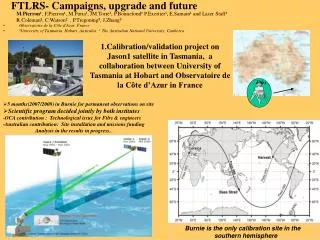
FTLRS- Campaigns, upgrade and future Ftlrs M.Pierron¹, F.Pierron¹, M.Furia¹, JM.Torre¹, P.Bonnefond¹ P.Exertier¹, E.Samain¹ and Laser Staff¹ R.Coleman², C.Watson² , P.Tregoning³, J.Zhang³ • Observatoire de la Côte d'Azur, France • ²University of Tasmania, Hobart, Australia, ³ The Australian National University, Canberra 1.Calibration/validation project on Jason1 satellite in Tasmania, a collaboration between University of Tasmania at Hobart and Observatoire de la Côte d’Azur in France • 5 months(2007/2008) in Burnie for permanent observations on site • Scientific program decided jointly by both institutes • -OCA contribution : Technological issue for Ftlrs & engineers • -Australian contribution: Site installation and missions funding • Analysis in the results in progress.. Burnie is the only calibration site in the southern hemisphere
Real Time System: chronometry part At firing interrupt Internal Timer Read internal timer External PC Stanford chronometer 2 Dassault Timer TCPIP link • Read Stanford Chronometer • Read the 2 Dassault timers • (firing/return events) First T2L2 results : Ftlrs at Grasse & Ajaccio with MEO at Grasse July 2008 on Jason2 some days after launch Timers server interface At gate interrupt Ftlrs Upgrade in Summer 2008:Dassaults Event timer installation & T2L2 • Our choice has been to conserve the 2 timing systems very useful for engineering & failure • internal timer and Stanford chronometer • Two Dassault timers (start and stop channels)