Enhancing Instructional Practice with Depth of Knowledge (DOK) Mindset
180 likes | 292 Vues
Gain understanding of DOK and SLOs, practice rating academic goals, write statements of intended learning, explore DOK within Colorado Academic Standards, and learn about Hess’s Cognitive Rigor. Engage in activities to enhance teaching and learning.


Enhancing Instructional Practice with Depth of Knowledge (DOK) Mindset
E N D
Presentation Transcript
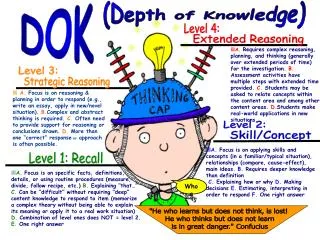
Depth of Knowledge (DOK) DOK as: A Mindset -and- Within the Context of Student Learning Objectives (SLOs)
Today’s Agenda • All Licensed Educators; Variety of grade and content areas • Terminology Considerations • Content area/Grade level Tally and Grouping • Parking Lot • Depth of Knowledge (DOK) • DOK within the context of Student Learning Objectives (SLOs) • Intended Outcomes: • Participants will gain a basic understanding of DOK and its purpose as it applies to instructional practice, particularly within the framework of Student Learning Objectives (SLOs) • Participants will have engaged in practice with rating academic goals with a DOK level • Participants will gain a basic understanding of the purpose, structure, and benefits of Student Learning Objectives (SLOs) • Participants will grasp the process of writing a Statement of Intended Learning for their own content area/grade level
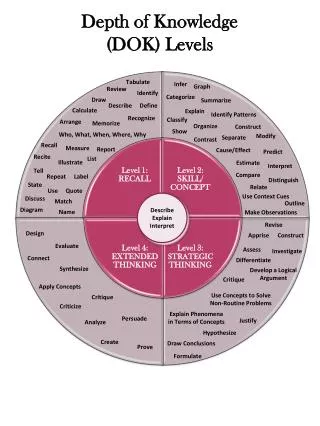
Depth of Knowledge (DOK) Overview DOK within the context of the Colorado Academic Standards (CAS) Item Examples and DOK
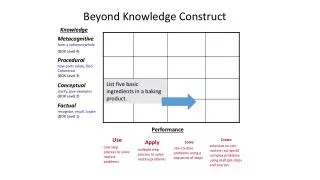
Hess’s Cognitive Rigor (DOK+Bloom’s Taxonomy - Math+Science )
DOK - Item Samples PARCC / CMAS samples: http://www.parcconline.org/samples/item-task-prototypes “increased rigor; deeper understanding” High DOK in MC items is difficult but possible. See Scientific Literacy Handout.
Activity: Academic Goals for a Term and DOK (pt. 1) • Handout: Samples of Goals for a Term • Please collaborate at your table/with your group (if applicable) and determine the DOK level of two goals (refer to DOK handouts if necessary) ..and why • Note: Consensus ideal but not required • Share out/Discussion of ratings
Activity: Academic Goals for a Term and DOK (pt. 2) Explanation of this type of goal (Statement of Intended Learning) [5 min break?]
Student Learning Objectives (SLOs) • Background/Purpose • SB 10-191; 50% Student Growth • Pre-post concept; Assessment Collaboratives • Aligned with the Teaching and Learning Cycle • Provide flexibility and autonomy to their creators • Definition: Measurable instructional goals that are based on the academic standards and established for a specific group of students (usually a class) over a set period of time (usually a term)
Student Learning Objectives (SLOs) SLOs are NOT: a simple computation of pre-post assessment score differences; results based on only ONE measure or assessment instrument; an “add-on” for teachers engaged in effective teaching practices 2013-14 Pilot Components/Form
Depth of Knowledge (DOK) in the context of Student Learning Objectives (SLOs) • Striving for Higher DOK levels should be a mindset that applies to the Teaching/Learning Cycle in general. • The DOK level of the Statement of Intended Learning in your SLO should be matched by the same level DOK for: • Assessment (items; rubrics) • Learning Targets (by default) • Progress Monitoring (looking for evidence)
Optional Activity on your own time: Write a Statement of Intended Learning Individually or with colleagues, write a first draft of a Statement of Intended Learning while referring to the CO Academic Standards. Keep in mind your intended level of DOK. Following this session: You can submit for feedback but MUST include complete Standards reference and content/grade level information: mdlewis@aps.k12.co.us
In Conclusion… • We are developing PD for teachers in collaboration with Div. of Equity in Learning and Div. of Human Resources • Linking QS 1-5 to QS 6 • Linking Pacing Guides to Educator Effectiveness • Implementation planning • In-person trainings • Screencasts • SLO Bank • pte.aurorak12.org (our website) • http://www.wested.org/resources/depth-of-knowledge-and-critical-thinking/ (webinar on DOK) • http://www.coloradoplc.org/assessment (CDE Assessment Bank) Questions?