Preliminary Coexistence Tests
This study analyzes the effects of various interference signals on a WLAN operating at 2.412 GHz. Utilizing a 0 dBm victim signal with a 20 MHz bandwidth, we examine the impact of continuous wave AM, Bluetooth, LTE, and another WLAN signal as interferers. Key findings reveal that while the WLAN maintains functionality against CW AM interference, Bluetooth and LTE significantly degrade performance, leading to intermittent failures. RMS EVM measures highlight the differences in signal integrity, showing that LTE, with its wider bandwidth, presents the most formidable challenge.

Preliminary Coexistence Tests
E N D
Presentation Transcript
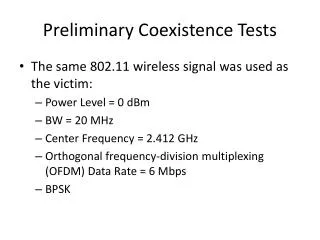
Preliminary Coexistence Tests • The same 802.11 wireless signal was used as the victim: • Power Level = 0 dBm • BW = 20 MHz • Center Frequency = 2.412 GHz • Orthogonal frequency-division multiplexing (OFDM) Data Rate = 6 Mbps • BPSK
OFDM concept Transmit data is spread over a number of orthogonal subcarriers in the frequency domain
Error vector magnitude (EVM) measurement of the receive signal constellation
Comparing Impacts of Different Interference Modulation/Technologies • Setup • Currently conductive • Eventually move to radiated • Target protocol – WLAN • Interfering Modulation/Technologies • CW AM Signal • Bluetooth (BT) • LTE • WLAN
Interfering signal spectrums (with 20 MHz WLAN at center frequency = 2.417 GHz)
Interfering Signal 1: CW AM Signal • Parameters: • Center Frequency = 2.41 GHz (within, but off center, of WLAN band) • AM Modulation: 1 kHz and 80% (as in IEC 61000-4-3, Annex A) • Power level = -10 dBm • WLAN does not fail • RMS EVM of approx. -23 dBm (by inspection) as an instant average over all subcarriers
Interfering Signal 2: Bluetooth • Parameters • Power Level = -10 dBm • Center Frequency = 2.41 GHz (same as Signal 1) • Max Payload length, Carrier Burst • WLAN intermittently fails as a result of the BT signal • RMS EVM of WLAN is regularly about -50 dBm (by inspection), with short periods of Higher EVM (at failure) • Consistently much lower EVM from signal 1
Received WLAN Constellation with Interfering Signal 2, WLAN Failure
Recieved WLAN EVM Spectrum with Interfering Signal 2, WLAN Failure
Interfering Signal 3: LTE • Parameters • Power Level = -10 dBm • Center Frequency = 2.41 GHz • BW = 10 MHz • With these Parameters the WLAN Receiver was never able to establish a link
Interfering Signal 3: LTE Cont. • Highest 10 MHz LTE power that allowed the WLAN system to make a connection was -27 dBm • Consistent EVM of about -25 dBm (by inspection) • Large number of subcarriers are affected (see following EVM plot) by this signal • This is due to the wider bandwidth of LTE compared to Bluetooth or the CW AM signal
Received WLAN Constellation with Interfering Signal 3 (-27 dBm Power)
Recieved WLAN EVM Spectrum with Interfering Signal 3 (-27 dBm Power)
Interfering Signal 4: 802.11 WLAN • The interfering WLAN is on the 802.11 band nearest the victim: • Power = -30 dBm • Center Frequency = 2.417 GHz • BW = 20 MHz • -30 dBm interference power setting was the highest that allowed consistent victim connection • Consistent average RMS EVM of about –29 dBm (from inspection)
Received WLAN Constellation with Interfering Signal 2, No WLAN Failure
Recieved WLAN EVM Spectrum with Interfering Signal 2, no WLAN Failure
Peak Spectrum Comparison of CW AM, Bluetooth , and LTE from Tests