Comprehensive Guide to Solving Quadratic Equations
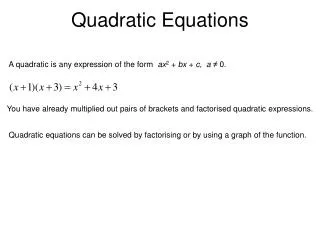
This guide provides an in-depth overview of solving quadratic equations in the form ax² + c = 0 and ax² + bx + c = 0. It covers essential techniques, including isolating the squared term, taking square roots, and applying the Zero Product Rule (Null Factor Law). Step-by-step examples illustrate how to factor out the greatest common factor (GCF) and set equations equal to zero. Additionally, homework exercises reinforce understanding, allowing students to practice key concepts. Perfect for students at all levels looking to master quadratic equations.

Comprehensive Guide to Solving Quadratic Equations
E N D
Presentation Transcript
Material Taken From:Mathematicsfor the international student Mathematical Studies SLMal Coad, Glen Whiffen, John Owen, Robert Haese, Sandra Haese and Mark BruceHaese and Haese Publications, 2004
Solving Quadratic Equations ax2 + c = 0 isolate the squared term take the square root of both sides consider solve
Solve for x 1) 2x2+ 1 = 15 • 2 – 3x2 = 8
Solve for x • (x – 3)2 = 16 • (x + 2)2 = 11
Solve for x • 3x(x – 5) = 0 • (x – 4)(3x + 7) = 0
Solving Quadratic Equations ax2 + c = 0 ax2 + bx = 0 isolate the squared term take the square root of both sides consider solve set equal to zero factor out the GCF use the zero product property solve
Solve for x • x2= 3x • 2x2+ 8x = 0
Solving Quadratic Equations ax2 + c = 0 ax2 + bx = 0 ax2 + bx + c = 0 set equal to zero factor out the GCF, if possible factor use the zero product property solve isolate the squared term take the square root of both sides consider solve set equal to zero factor out the GCF use the zero product property solve
Solve for x • x2= x + 30 • 3x2= 4x – 1
Solve for x • 12x2 – 5x = 2
Homework • Exercise 8E.1, pg255 #1acegi #2acei • Exercise 8E.2, pg 257 #1acfk • Exercise 8E.3, pg 257 #1ace #2acegj #3acegik #4ac #6aceg