Download
1 / 8
80 likes | 215 Vues
This document explores the integration of agents and the Semantic Web for efficient calendar management. It describes how knowledge is encoded using ontologies like Dublin Core, Hybrid iCal, and VCard to create rich metadata for events. These agents utilize semantic query languages to assist users in generating reminders and managing tasks, such as booking flights. By representing events in RDF, key properties like time, location, and attendee information are easily accessible and interoperable across different systems. This approach enables seamless scheduling and efficient event management.

E N D
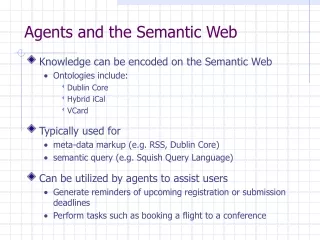
Agents and the Semantic Web • Knowledge can be encoded on the Semantic Web • Ontologies include: • Dublin Core • Hybrid iCal • VCard • Typically used for • meta-data markup (e.g. RSS, Dublin Core) • semantic query (e.g. Squish Query Language) • Can be utilized by agents to assist users • Generate reminders of upcoming registration or submission deadlines • Perform tasks such as booking a flight to a conference
Events on the Semantic Web • Calendars, Schedules and Events can be represented in RDF • Events have several properties, including: • Time / Duration • Attendee Information • Location • Description • Event concepts can refer to existing concepts on the SW • Reuse of semantic information supports reasoning and inference • Interoperability possible between different ontologies • E.g. VCard, DAML-ITTalks & FOAF ontologies • Supports markup of reminders and recurring events • E.g. Class Schedules!
Winner Semantic Web Working Symposium 2001 Challenge Retsina Semantic Web Calendar Agent Terry R. Payne, Rahul Singh & Katia Sycara • CMU Response to SWWS2001 Challenge “Import RDF Schedules into Outlook” • Parses RDF Schedules • Based on Hybrid iCal Ontology • Libby Miller (Bristol, UK) • Michael Arick (UC Santa Cruz) • Outlook-Agent integration • RDF Schedules in to Outlook • using OLE Automation http://www.daml.ri.cmu.edu/Cal
Retsina Semantic Web Calendar Agent • Allows user to browse SW schedules & events • Displays event, location and attendee information • Supports additional actions based on available information • E.g. email or visit web page if information is available • Supports serendipitous exploration • Uses agent discovery (DAML-S) to locate context dependent agents • Imports schedules into MS Outlook • User can select schedules to import into Outlook Calendar • Can receive KQML requests to autonomously import schedule without invoking browser http://www.daml.ri.cmu.edu/Cal
Supporting Distributed Meeting Scheduling • Schedules can be: • Browsed and imported by user • Shared and imported autonomously by agents • Assists users in keeping calendar “up-to-date” • Higher fidelity model of user’s schedule • Minimal cost on the user’s time • Supports meeting scheduling • Calendar Agents negotiate possible meeting times based on user’s schedule and preferences