Human Dissection: What Future Doctors Really Learn Beyond Anatomy
0 likes | 3 Vues
Discover opportunities to engage in anatomy courses and register for immersive training at https://idissect.ca/registration u2014 where aspiring clinicians can build confidence and competence through hands-on experience.


Human Dissection: What Future Doctors Really Learn Beyond Anatomy
E N D
Presentation Transcript
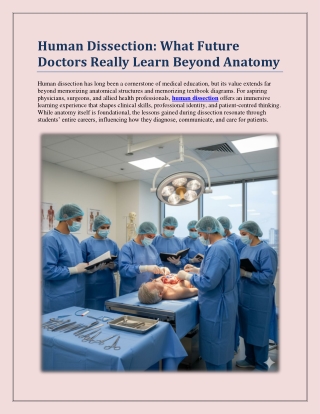
Human Dissection: What Future Doctors Really Learn Beyond Anatomy Human dissection has long been a cornerstone of medical education, but its value extends far beyond memorizing anatomical structures and memorizing textbook diagrams. For aspiring physicians, surgeons, and allied health professionals, human dissection offers an immersive learning experience that shapes clinical skills, professional identity, and patient-centred thinking. While anatomy itself is foundational, the lessons gained during dissection resonate through students’ entire careers, influencing how they diagnose, communicate, and care for patients.
At the most obvious level, human dissection provides an unparalleled opportunity to observe real human anatomy in three dimensions. Textbooks and digital reconstructions are invaluable, but they cannot fully replicate the tactile feedback, texture, and spatial complexity of real tissue. Through dissection, students encounter the true variability of the human body — differences in muscle attachment, nerve pathways, and vascular arrangements that no two individuals share exactly. This exposure enriches a future doctor’s understanding of how anatomy translates into clinical variability and surgical nuance. Yet, the educational value extends well beyond identifying anatomical landmarks. One of the most profound lessons students absorb is the importance of precision and patience. Dissection requires careful manipulation of delicate structures with steady hands and focused attention. These are the same skills that surgeons rely on in the operating room, where millimetres can make the difference between successful outcomes and complications. Additionally, the methodical approach cultivated during hours at the dissection table reinforces habits of discipline and attention to detail essential in all medical practice. Another often underestimated benefit of dissection is its role in developing comfort with the physical realities of medicine. Encountering the human body in such an intimate and direct way prepares students for clinical scenarios involving wounds, surgical fields, and physical examination findings that might otherwise be intimidating. This early exposure reduces apprehension and builds confidence, allowing future healthcare providers to focus on clinical reasoning and patient care rather than personal discomfort. Human dissection also fosters collaboration and communication among students. Anatomy labs are communal spaces where learners work in pairs or small groups to solve problems, discuss observations, and support each other through complex tasks. These interactions mirror the teamwork required in clinical settings — from ward rounds to multidisciplinary case conferences. Through shared experiences at the dissection table, students learn to articulate findings, listen to peers, and negotiate different perspectives — all essential skills for effective healthcare teams. Ethical reflection is another integral, though less overt, aspect of human dissection. Working with donated bodies invites contemplation of the profound gift provided by donors and their families. Many medical programs incorporate discussions on respect, dignity, and professional conduct, encouraging students to reflect on the human stories behind the specimens. This ethical grounding strengthens empathy and reminds future doctors of their responsibility to honour trust and care for living patients with similar respect. Additionally, dissection encourages problem-solving and critical thinking. While identifying structures is part of the process, correlating anatomical relationships with physiological function and clinical relevance pushes students to think beyond the surface. For example, recognizing how the arrangement of muscles and nerves contributes to movement limitations can deepen understanding of patient symptoms and guide more effective treatment strategies. This analytical practice becomes second nature and transfers seamlessly into clinical decision-making.
Finally, human dissection can cultivate a lifelong commitment to learning. Medicine is an ever- evolving field, and the habits developed through early, hands-on anatomical study — curiosity, observation, and a willingness to question — are foundations for ongoing professional growth. Many physicians look back on their dissection experiences as transformational moments that ignited their passion for discovery and a deeper appreciation for the human body. This article explores what future medical professionals truly gain from human dissection beyond basic anatomical knowledge — from clinical skills and teamwork to ethical reflection and lifelong learning. Discover opportunities to engage in anatomy courses and register for immersive training at https://idissect.ca/registration — where aspiring clinicians can build confidence and competence through hands-on experience. A thoughtful guide for students considering dissection courses, this piece highlights the lasting impact of early anatomical education on medical careers.









![Download Book [PDF] Human Anatomy Coloring Book: All Human Body Systems With Ove](https://cdn7.slideserve.com/12480277/slide1-dt.jpg)
![[READ DOWNLOAD] Anatomy: A Photographic Atlas](https://cdn7.slideserve.com/12504367/slide1-dt.jpg)