Download
1 / 4
0 likes | 0 Vues
Learn why Local Exhaust Ventilation Testing Services are essential for workplace safety and compliance, and how training like the Local Exhaust Ventilation (LEV) Basics Course supports effective risk control.

E N D
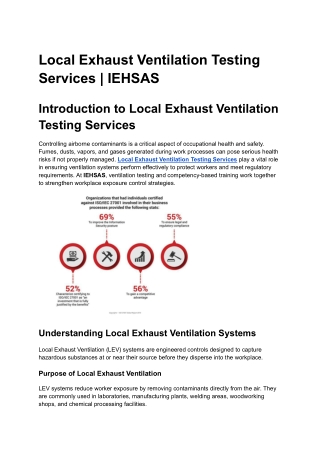
Local Exhaust Ventilation Testing Services | IEHSAS Introduction to Local Exhaust Ventilation Testing Services Controlling airborne contaminants is a critical aspect of occupational health and safety. Fumes, dusts, vapors, and gases generated during work processes can pose serious health risks if not properly managed. Local Exhaust Ventilation Testing Services play a vital role in ensuring ventilation systems perform effectively to protect workers and meet regulatory requirements. At IEHSAS, ventilation testing and competency-based training work together to strengthen workplace exposure control strategies. Understanding Local Exhaust Ventilation Systems Local Exhaust Ventilation (LEV) systems are engineered controls designed to capture hazardous substances at or near their source before they disperse into the workplace. Purpose of Local Exhaust Ventilation LEV systems reduce worker exposure by removing contaminants directly from the air. They are commonly used in laboratories, manufacturing plants, welding areas, woodworking shops, and chemical processing facilities.
Key Components of an LEV System An LEV system typically consists of a hood or capture device, ducting, an air-cleaning device such as a filter, and a fan to move contaminated air away from workers. Each component must function correctly for the system to be effective. Why Local Exhaust Ventilation Testing Services Are Essential Installing an LEV system alone is not enough. Performance must be verified and maintained over time. Ensuring System Effectiveness Local Exhaust Ventilation Testing Services confirm that airflow rates, capture velocities, and filtration efficiency meet design and regulatory standards. Testing identifies blockages, wear, or design flaws that could compromise worker protection. Legal and Compliance Requirements Many occupational safety regulations require LEV systems to be thoroughly examined and tested at defined intervals. Documented testing demonstrates due diligence and helps organizations meet inspection and audit requirements. Health Risks of Poor Ventilation Control When LEV systems underperform, workers may be exposed to harmful substances without realizing it. Short-Term and Long-Term Health Effects Short-term exposure may cause irritation, headaches, or dizziness, while long-term exposure can lead to respiratory disease, occupational asthma, or other chronic conditions. Regular testing reduces these risks significantly. Impact on Productivity and Morale Poor air quality affects concentration, comfort, and absenteeism. Effective ventilation supported by Local Exhaust Ventilation Testing Services contributes to a healthier and more productive workforce. The Role of Training in LEV Management Testing is most effective when supported by competent personnel who understand how LEV systems work.
Importance of LEV Knowledge Supervisors and safety professionals need the skills to recognize when systems are underperforming and when testing or maintenance is required. Value of the Local Exhaust Ventilation (LEV) Basics Course The Local Exhaust Ventilation (LEV) Basics Course builds foundational knowledge of system design, operation, and limitations. This training helps organizations communicate effectively with testing providers and take informed action based on test results. Integrating Testing into Workplace Safety Programs LEV testing should be part of a broader occupational hygiene and safety management system. Scheduled Testing and Preventive Maintenance Routine testing at planned intervals ensures small issues are identified before they escalate into serious failures. Preventive maintenance improves system lifespan and reliability. Using Test Data for Continuous Improvement Test reports provide measurable data on system performance. Analyzing trends over time supports better system design, targeted upgrades, and improved exposure control strategies. Documentation and Risk Management Benefits Accurate records from Local Exhaust Ventilation Testing Services are essential for effective risk management. Supporting Risk Assessments LEV test results feed directly into exposure assessments and control evaluations, ensuring risk assessments remain evidence-based and current. Audit and Insurance Advantages Clear documentation strengthens audit outcomes and may support insurance negotiations by demonstrating proactive risk control and compliance. FAQ: Local Exhaust Ventilation Testing Services What are Local Exhaust Ventilation Testing Services?
They involve the examination and measurement of LEV systems to confirm they are capturing and removing airborne contaminants effectively. How often should LEV systems be tested? Testing frequency depends on regulations, risk level, and system use, but many workplaces require thorough examination at least annually. Who should arrange LEV testing? Employers are responsible for ensuring systems are tested by competent professionals and that findings are acted upon. Why is training important alongside testing? Training, such as the Local Exhaust Ventilation (LEV) Basics Course, helps staff understand results, recognize issues, and maintain system effectiveness between tests. Are LEV systems only needed in industrial settings? No. LEV systems are also critical in laboratories, workshops, healthcare facilities, and any environment where airborne contaminants are generated. Conclusion: Airborne hazards present a silent but serious risk in many workplaces. Local Exhaust Ventilation Testing Services ensure that critical engineering controls perform as intended, safeguarding worker health and supporting legal compliance. When combined with competency development through the Local Exhaust Ventilation (LEV) Basics Course, organizations gain both technical assurance and internal capability. With IEHSAS expertise, ventilation management becomes a proactive, data-driven approach that strengthens occupational health, safety, and long-term operational performance.