Understanding Feedback Systems in Cybernetics and Their Application in Game Design
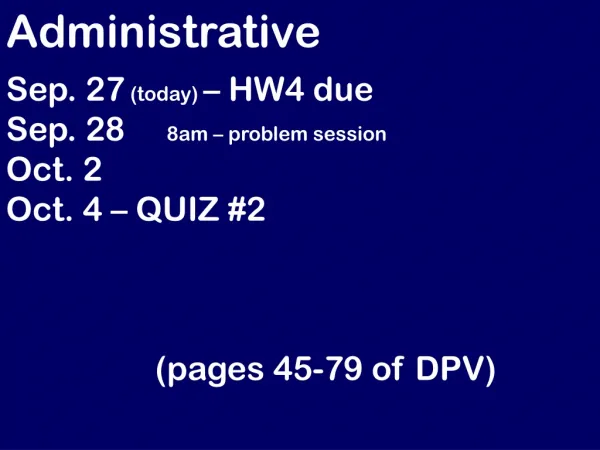
This week's administrative update emphasizes the importance of the Design Analysis Project due on April 7th, which counts for 15% of your final grade. Students are reminded of the rigorous grading criteria focusing on effort and quality. Additionally, prepare for Test #2 on April 4th, covering concepts from Unit 2 and exploring cybernetics and feedback loops in dynamic systems. Key topics include the role of feedback in organizations, as well as the impact of feedback systems on game mechanics, balanced difficulty, and player experiences.

Understanding Feedback Systems in Cybernetics and Their Application in Game Design
E N D
Presentation Transcript
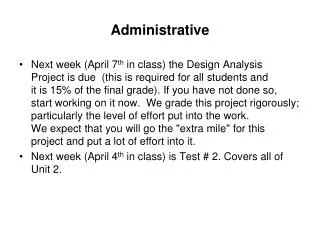
Administrative • Next week (April 7th in class) the Design AnalysisProject is due (this is required for all students andit is 15% of the final grade). If you have not done so,start working on it now. We grade this project rigorously;particularly the level of effort put into the work.We expect that you will go the "extra mile" for thisproject and put a lot of effort into it. • Next week (April 4th in class) is Test # 2. Covers all of Unit 2.
Cybernetics • Resulted from Information Theory (Ch. 16) and Information Systems Theory (Ch. 17) • Focus on how dynamic systems change over time • Cybernetics is used to study organizations • Large companies • Governments • Basic principle: output-feedback-adjustment
feedback output adjustment Elements of a Cybernetic System“The feedback Loop” Environment Sensor Comparator Activator • AC-unit-in-a-room example
Kinds of Feedback • Example of each for the AC-unit-in-a-room example • Negative: temperature(room) > 75 then activate cooler • Positive: temperature(room) > 75 then activate heater
Simple Cybernetic Design • Lets combine two feedback loops that maintains the temperature in a room stays between 65 and 75 • We have a cooler and • We have a heater • Lets do one that maintains the temperature in a room at 70. Same conditions as before
Example of “this stuff” in games? • Positive/negative feedback in games? • An example of positive feedback • An example of negative feedback
Game state feedback Scoring function output adjustment Game Controller Game mechanical bias • Information known to all players • Information known to only one player • Information known to the game only • Randomly generated information Game state Feedback Loops in Games(Marc LeBlanc) Environment Sensor Comparator Activator
Example of negative Feedback: Downforce • Negative: • Simulated gravity vs. player • AI lets itself catch-up if you are loosing • AI catches up if you are winning http://www.youtube.com/watch?v=z-OQzqUdbs4 http://www.youtube.com/watch?v=37g5uNwmqz4
AI lets itself catch-up if you are loosing • Position of autos • Configuration of track • … feedback Game state Scoring function • Player position, leadingCar position • Formally: Distance(player,finish), Distance(leadingCar,finish) adjustment output Game mechanical bias Game Controller • Slow down leading-car • Formally: • speed(leadingCar) • speed(player) f(Distance(player, leadingCar) • Player loosing? Formally: • Distance(player, finish) > Distance(leadingCar, finish)
Simulated gravity vs player control • Position of autos • Configuration of track • speed… feedback Game state Scoring function • Player direction • Road direction adjustment output Game mechanical bias Controller • Steer car towards road • Player going out of road?
Mortal Combat: combo • Health Points player • Health points opponent • Disabled (Yes, No) • Opponent situation (chance for next combo, no chance) Game state feedback Scoring function • Disabled, • Opponent situation adjustment output Controller Game mechanical bias • Disabled = Yes • Opponent situation = chance for next combo • Disabling attack
Difficulty LevelsBrigette Swan • Adaptation to the quirks and habits of a particular player over time. • Many games implement difficulty sliders. • Common: • start early levels easy • More difficult as game progresses • Difficulty can be amount of information available! • Dynamic Difficulty Adjustment (DDA)
Dynamic Difficulty Adjustment (DDA)-- The Oblivion Controversy • Idea: adjust game so that it remains challenging (negative feedback) • It is an RPG game like say Diablo but… • As your avatar levels so do all mobs in the game • So for example you “clean” a dungeon at level 1 killing some rats, at level 10 those rats will be armored and will hit much harder • Does it still have meaningful play as a result?
Use of Feedback in Games (Marc LeBlanc) Examples? • Stability: • Negative feedback stabilizes a game • Positive feedback destabilizes a game • Game duration • Negative feedback can prolong a game • Positive feedback can end it • Success: • Positive feedback magnifies early success • Negative feedback magnifies late ones • Control: • Feedback systems can emerge from games • Feedback systems can take control away from gamers • … and result in lost of meaningful play!