Understanding Firewall Configurations: Types, Criteria, and Practical Applications
90 likes | 199 Vues
Firewalls serve as essential network appliances that filter traffic based on various criteria, primarily operating at layers 3 to 5 of the OSI model. They examine headers for destination/source IPs, ports, and TCP flags. Different types of firewalls include static, dynamic, stateful packet filtering, and proxy servers, each with unique capabilities. Static filtering relies on access control lists (ACLs), while dynamic and stateful filtering improve upon it by maintaining session tables and better handling application behaviors. Understanding these aspects is crucial for effective network management and security.


Understanding Firewall Configurations: Types, Criteria, and Practical Applications
E N D
Presentation Transcript
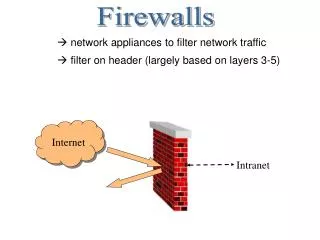
Internet Intranet Firewalls network appliances to filter network traffic filter on header (largely based on layers 3-5)
Firewall Filtering Criteria Destination IP Source IP Destination Port Source Port Flag (TCP-only) ACK - acknowledge FIN - final PSH - push RST - reset SYN - synchronize URG - urgent
Firewall Types static packet filtering dynamic packet filtering stateful packet filtering proxy server
static packet filtering packet Network manager configures access control lists Packets are compared to access control lists Example: block
0 - echo reply 3 - destination unreachable 4 - source quench (from overloaded router) 5 - redirect (indicates a better path) 6 - echo request 9 - router advertisement (fore new routers) 10 - router solicitation (host request for advertisement) 11 - time exceeded (packet header may include time) 12 - parameter problem (catch all for errors) 13 - time stamp request (checking link speed) 14 - time stamp reply Problems with static filtering • Blocking FIN scanning • Difficult to filter • Difficult to filter Internet Control Message Protocol - designed for Internet testing/maintenance - does not use ports - has type field
dynamic packet filtering ACLs packet Includes all capabilities of static filtering Maintains an Active Sessions Table Example: block external FIN scan
stateful packet filtering ACLs Active Sessions Table packet Includes all capabilities of dynamic filtering Also “understands” certain application behavior Example: better control over UDP, NFS, RPC
proxy server packet destination Messages to destination IP are rerouted to a proxy The proxy communicates on behalf of the destination The proxy may also communicate with destination