Understanding Projectile Motion: Concepts, Equations, and Analysis
This guide delves into projectile motion, a type of motion experienced by objects thrown into the air, influenced by gravity, without propulsion. We explore horizontal and vertical components of motion, emphasizing the independence of these components. Fundamental concepts such as trajectory, time of flight, horizontal range, and final velocity are analyzed using relevant equations. Both horizontal and angled projections are covered, with an emphasis on factors like initial velocity, angle of projection, and maximum height. This comprehensive overview simplifies the understanding of how projectiles behave under the influence of gravity.

Understanding Projectile Motion: Concepts, Equations, and Analysis
E N D
Presentation Transcript
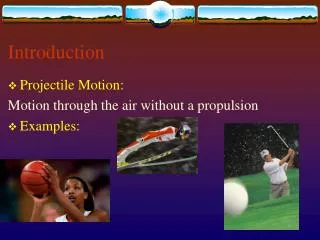
Introduction • Projectile Motion: Motion through the air without a propulsion • Examples:
y v0 x
y x
y x
y x
y x
y • Motion is accelerated • Acceleration is constant, and downward • a = g = -9.81m/s2 • The horizontal (x) component of velocity is constant • The horizontal and vertical motions are independent of each other, but they have a common time g = -9.81m/s2 x
ANALYSIS OF MOTION • ASSUMPTIONS: • x-direction (horizontal): uniform motion • y-direction (vertical): accelerated motion • no air resistance • QUESTIONS: • What is the trajectory? • What is the total time of the motion? • What is the horizontal range? • What is the final velocity?
y v0 g h x 0 Frame of reference: Equations of motion:
y h v02 > v01 v01 x Trajectory x = v0 t y = h + ½ g t2 Parabola, open down Eliminate time, t t = x/v0 y = h + ½ g (x/v0)2 y = h + ½ (g/v02) x2 y = ½ (g/v02) x2 + h
y h Δt = √ 2h/(9.81ms-2) Δt = √ 2h/(-g) x Total Time, Δt Δt = tf - ti y = h + ½ g t2 final y = 0 0 = h + ½ g (Δt)2 ti =0 Solve for Δt: tf =Δt Total time of motion depends only on the initial height, h
y h Δt = √ 2h/(-g) Δx = v0 √ 2h/(-g) Δx x Horizontal Range, Δx x = v0 t final y = 0, time is the total time Δt Δx = v0 Δt Horizontal range depends on the initial height, h, and the initial velocity, v0
v v = √vx2 + vy2 = √v02+g2t2 tg Θ = vy/ vx = g t / v0 VELOCITY vx = v0 Θ vy = g t
Δt = √ 2h/(-g) tg Θ = g Δt / v0 = -(-g)√2h/(-g) / v0 = -√2h(-g) / v0 v v = √vx2 + vy2 v = √v02+g2(2h /(-g)) v = √ v02+ 2h(-g) FINAL VELOCITY vx = v0 Θ vy = g t Θ is negative (below the horizontal line)
HORIZONTAL THROW - Summary h – initial height, v0 – initial horizontal velocity, g = -9.81m/s2
y Initial velocity: vi = vi [Θ] Velocity components: x- direction : vix = vi cos Θ y- direction : viy = vi sin Θ viy vi θ x vix Initial position: x = 0, y = 0
y a = g = - 9.81m/s2 • Motion is accelerated • Acceleration is constant, and downward • a = g = -9.81m/s2 • The horizontal (x) component of velocity is constant • The horizontal and vertical motions are independent of each other, but they have a common time x
ANALYSIS OF MOTION: • ASSUMPTIONS • x-direction (horizontal): uniform motion • y-direction (vertical): accelerated motion • no air resistance • QUESTIONS • What is the trajectory? • What is the total time of the motion? • What is the horizontal range? • What is the maximum height? • What is the final velocity?
Trajectory x = vi t cos Θ y = vi tsin Θ + ½ g t2 Parabola, open down y Eliminate time, t t = x/(vi cos Θ) y = bx + ax2 x
0 =vi sin Θ + ½ g Δt Δt = 2 vi sinΘ (-g) Total Time, Δt y = vi tsin Θ + ½ g t2 final height y = 0, after time interval Δt 0 =vi Δtsin Θ + ½ g (Δt)2 Solve for Δt: x t = 0 Δt
2 vi sinΘ Δt = (-g) Δx = 2vi 2 sin Θ cos Θ vi 2 sin (2Θ) Δx = (-g) (-g) Horizontal Range, Δx x = vi t cos Θ y final y = 0, time is the total time Δt Δx = vi Δt cos Θ x 0 sin (2Θ) = 2 sin Θ cos Θ Δx
vi 2 sin (2Θ) Δx = (-g) Horizontal Range, Δx • CONCLUSIONS: • Horizontal range is greatest for the throw angle of 450 • Horizontal ranges are the same for angles Θ and (900 – Θ)
Trajectory and horizontal range vi = 25 m/s
Velocity • Final speed = initial speed (conservation of energy) • Impact angle = - launch angle (symmetry of parabola)
tup= hmax =vi t upsin Θ + ½ g tup2 hmax =vi2sin2Θ/(-g) + ½ g(vi2sin2Θ)/g2 hmax = vi sin Θ (-g) vi2sin2Θ 2(-g) Maximum Height vy = vi sin Θ + g t y = vi tsin Θ + ½ g t2 At maximum height vy = 0 0 = vi sin Θ + g tup tup= Δt/2
vi 2 sin (2Θ) (-g) Projectile Motion – Final Equations (0,0) – initial position, vi = vi [Θ]– initial velocity, g = -9.81m/s2 2 vi sinΘ (-g) vi2sin2Θ 2(-g)
PROJECTILE MOTION - SUMMARY • Projectile motion is motion with a constant horizontal velocity combined with a constant vertical acceleration • The projectile moves along a parabola