Download
1 / 26
260 likes | 360 Vues
Explore the National Income Accounts and Balance of Payments concepts, including GNP, GDP, CA, S, I, and BOP bookkeeping. Learn how income, expenditure, savings, and trade balances impact a country's financial status and international transactions.

E N D
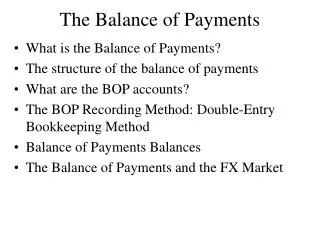
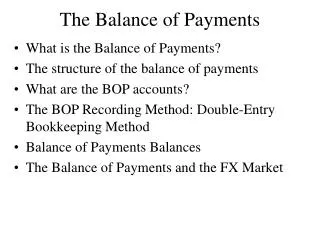
Content • Objectives • The National Income Accounts • S, I, and CA • The BOP Accounts • Bookkeeping • Summary
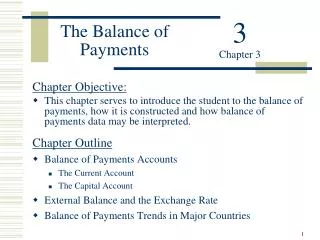
Objectives • To review national income accounting • The national income accounts record all the income and expenditures of a country. • To review balance of payments accounting • The balance of payments accounts record all international transactions of a country.
The National Income Accounts • Gross National Product (GNP) • The value of all final goods and services produced by a country’s factors of production and sold on the market in a given time period. • The Output of a country in a given time period.
The National Income Accounts • Gross Domestic Product (GDP) • The value of all final goods and services produced by the factors of production within a country’s borders. • GDP = GNP - net receipts of factor income from the rest of the world.
The National Income Accounts • The National Income Identity Y = C + I + G + EX – IM where: • Y is GNP • C is consumption • I is investment • G is government purchases • EX is exports • IM is imports
The National Income Accounts • Consumption (C) • The share of GNP consumed by the private sector. • Investment (I) • The share of GNP used by private firms to produce future output. • Government Purchases (G) • The share of GNP used by federal, state, or local governments
The National Income Accounts • Exports (EX) • The share of GNP exported to the rest of the world. • Imports (IM) • The share of GNP imported from the rest of the world.
The National Income Accounts • The Current Account (CA) • CA = EX – IM • A country has a CA surplus when its CA > 0. • A country has a CA deficit when its CA < 0. • CA measures the size and direction of international borrowing. • A country’s current account balance equals the change in its net foreign wealth.
Figure 12-2: The U.S. Current Account and Net Foreign Wealth Position, 1977-2000
US Current Account and Trade Balance(as a share of GDP) Sources: Congressional Budget Office; Department of Commerce, Bureau of Economic Analysis. Note: The vertical bars indicate periods of recession as defined by the National Bureau of Economic Research
S, I, and CA • National Savings (S) • The share of GNP that is not devoted to household consumption or government purchases. • S = Y – C – G • S = PS + GS
S, I, and CA • Private Savings (PS) • The share of disposable income saved. • PS = Y – T – C • Government Savings • The share of tax revenues (T) saved. • GS = T – G • Government budget deficit: G – T
S, I, and CA • The key relation: I = S – CA • S = PS + GS • PS = Y – T – C • GS = T – G • CA = EX – IM • Y = C + I + G + EX - IM
S, I, and CA • The current account is a measure of foreign savings at home. • Are current account deficits good? • The twin deficits hypothesis.
The BOP Accounts • The Balance of Payments (BOP) accounts is a record of all transactions between a country and the rest of the world. • Every transaction enters the BOP twice: once as a credit (+) and once as a debit (-).
The BOP Accounts • The Current Account (CA) • The current account divides exports and imports into three categories: • Merchandise trade • Services • Interest and dividend income
The BOP Accounts • The Capital and Financial Account (KA) • The capital and financial account records the exports and imports of assets. • Capital inflow: An export of assets. • Capital outflow: An import of assets.
The BOP Accounts • Official Reserve Transactions (ΔRFX) • Official international reserves • Foreign assets held by central banks. • Official foreign exchange intervention • Exchange rate intervention often requires to alter the amount of official reserves.
The BOP Accounts • The key relation: CA + KA = ΔRFX • This is an accounting identity • Accounting: • Exports are recorded as credits (+) in CA, KA • Imports are recorded as debits (-) in CA, KA
Bookkeeping • Example 1:A U.S. citizen buys a $1000 typewriter from an Italian company, and the Italian company deposits the $1000 in its account at Citibank in New York. • Entries in the U.S. balance of payments: • Purchases (imports) typewriter: Debit CA of $1000. • Sells (exports) asset: Credit to KA of $1000. • CA (-$1000) + KA (+$1000) = 0
Bookkeeping • Example 2: A U.S. citizen buys a $95 newly issued share of stock in the United Kingdom oil giant British Petroleum (BP) by using a check drawn on his stockbroker money market account. BP deposits the $95 in its own U.S. bank account at Second Bank of Chicago. • Entries in the U.S. balance of payments: • Purchases (imports) share: Debit to KA of $95. • Sells (exports) assets: Credit to KA of $95. • CA ($0) + KA (+$95 -$95) = 0
Bookkeeping • A reduction of official reserves: ΔRFX < 0 • An export of assets by the central bank. • An increase of official reserves: ΔRFX > 0 • An import of assets by the central bank. • So, changes in RFX similar to transactions in KA.
Summary • GNP measures the income and production of a country’s factors of production. • GDP measures the output produced within a country’s territorial borders. • Y = C + I + G + EX – IM • I = PS + GS – CA • The current account is a measure of the country’s net lending to foreigners.
Summary • The current account records net exports of goods and services. • The capital and financial accounts record net exports of assets. • BOP = CA + KA = ΔRFX • Exports are recorded as a credit. • Imports are recorded as a debit.