Download
1 / 39
400 likes | 525 Vues
This seminar focuses on essential presentation skills for chemical biology lectures. Learn how to effectively prepare for a talk, reduce nervousness through techniques like rehearsal and deep breathing, and handle unexpected challenges with ease. Discover strategies for engaging your audience, keeping their attention, and structuring your talk to convey your message clearly. This session emphasizes the importance of knowing your audience, utilizing varied learning styles, and maintaining confidence throughout your presentation.

E N D
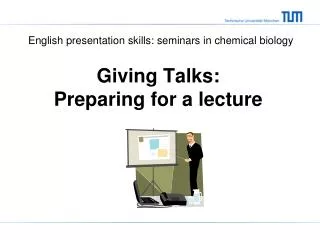
English presentation skills: seminars in chemical biology Giving Talks:Preparing for a lecture
Overview • The presenter • The audience • The talk: structure
Reduce nervousness: Rehearse & Prepare • Rehearse your talk: • Rehearsal reduces fear by 75% • (but don’t memorize it) • Prepare: • Familiarize yourself with seminar room • Make sure you have notes, extra copy of talk • Anticipate the unexpected
What unexpected things can happen? • You black out/loose your text • Solution: • Stay calm • Look up in your notes
What unexpected things can happen? • Laptop doesn’t work/not compatible with projector • Solution: • Bring USB key • Bring overhead slides
What unexpected things can happen? • Picture doesn’t show up • Solution: • Draw on whiteboard (if chemical structure) • Describe image • Explain conclusion
What unexpected things can happen? • Remote control doesn’t work • Solution: • Use keyboard on computer • Or (if computer out of reach) • Ask friend in audience to switch slides
Reduce nervousness: Other techniques • Acknowledge that you are nervous • But DON’T apologize for it • Breathing: • Practice deep breathing can reduce fear by 15% • Exercise: diaphragmatic breathing • 1. breathe slowly in through nose • 2. hold breath for 4 seconds • 3. breathe out through mouth
Reduce nervousness: Other techniques • Mental relaxation: • Listen music • Talk to audience members • Smile • Physical relaxation: • Exercise: hand clenching • 1. form fists with your hands • 2. push arms away from body • 3. slowly open hands
Getting in front of the audience • Generally, you will be announced as a speaker • Sit down, feet flat on floor • Stand up and walk forward confidently
Starting your talk • Without someone introducing you: • Get people’s attention & welcome them • Introduce yourself • Mention purpose of presentation • Mention how to deal with questions • With introduction: • Thank person who introduced you • Do NOT read the title of your presentation
Timing of talks • Long talks: 1h talk should be 45-50 minutes ~ 1 slide/minute • Short talks: time it well • Talk slow! • Respect your audience’s time!
Overview • The presenter • The audience • The talk: structure
Know your audience! • What do they want? • Connect with their expertise
Learning styles • Active vs Reflective (doing ↔ thinking it through) • Sensing vs Intuitive (facts ↔ relationships) • Sequential vs Global (steps ↔ big picture first) • Visual vs Verbal (pictures/diagrams ↔ text) • http://www.jcu.edu.au/office/tld/learningskills/learningst/questionnaire.html
Visual vs verbal: it’s not black and white • Mixed learning style: a bit of both
How to satisfy everyone • Make use of both diagrams AND text
How to satisfy everyone • Make use of both diagrams AND text
Attention span = short • 10 minutes: Audience attention <50% • BUT: attention floats away every 30 seconds! Mills, H.R. (1977) Techniques of Technical Training, 3rd Ed. Macmillan, London
Keep audience’s attention: voice • Vary volume, pitch, pace • Pausing • Repeat main points • Draw special attention to major conclusion
Voice • Articulation: • Pronounce consonants (b, c, d, f, g…) well • Open mouth for vowels (e, i, o…)
Keep audience’s attention: other tricks • Start strong: something surprising, provocative • Gaucher disease • Use humor: • Only if you feel comfortable doing it • Not at the cost of others
Keep audience’s attention: other tricks • Use metaphors/stories for illustration Collagen VII TANGO1 Malhotra et al., Cell 2009
Overview • The presenter • The audience • The talk: structure
Preparation • Misconception: ‘good science speaks for itself’ • What is the message?
Preparation • Read & understand the paper(s)! or • Understand your own work
The talk: structure • Attention span of the audience
The structure of a talk • Start broad, end broad! • Begin with the ‘big questions’ • Gradually zoom in on specific topic
The structure of a talk • In general: • Introduction: tell what you will say • Main part • Conclusion: tell what you’ve told
The structure of a talk • Gradually go in depth • Return to non-technical level -> regain general attention Nontechnical General technical Specialist
Short lectures: similar structure • For example: • first a schematic picture, then more complicated data Activity-based Probe (ABP) Tag Spacer Warhead
Give audience time to join back in • Make informative slide titles • Audience may loose attention, but still gets message blabla blabla blablabla
Give audience time to join back in • Make informative slide titles • Audience may loose attention, but still gets message blabla blabla blablabla
Give audience time to join back in • Make informative slide titles • Audience may loose attention, but still gets message • Make ‘overview’ slide that comes back • Clear transitions
Give audience time to join back in Blank out the topics that have passed
Give audience time to join back in • Make informative slide titles • Audience may loose attention, but still gets message • Make ‘overview’ slide that comes back • Clear transitions • Use pictures / clip art Something to look at
End of the talk • Acknowledge people (research talk) • Thank the audience • Take questions
Next part • Communication