Mastering Decimal Multiplication: A Step-by-Step Guide
This guide walks you through the process of multiplying decimals, using clear examples to illustrate each step. Start by multiplying normally as you would with whole numbers, then count the total number of decimal digits from the numbers being multiplied. We ensure that the final product has the same number of decimal places as the combined total. With practice problems included, you'll learn to handle decimal multiplication effortlessly and accurately.

Mastering Decimal Multiplication: A Step-by-Step Guide
E N D
Presentation Transcript
Example: 2.7 x 3.5
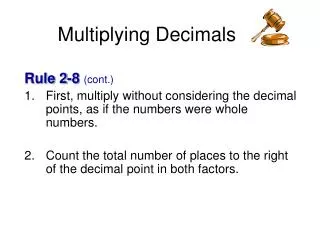
Step 1 Multiply as you normally would 27 x 35 945
Step 2 Count the number of digits behind a decimal point in the problem. This one has two digits behind the decimal point, the 7 and the 5. 2.7 x 3.5 =
Step 3 Put the decimal point in the answer. If your problem had 2 digits behind a decimal point, your answer should have 2 digits behind a decimal point.
If your problem had 3 digits behind a decimal point, your answer should have 3 digits behind a decimal point.
If your problem had 4 digits behind a decimal point, your answer should have 4 digits behind a decimal point.
Step 4 Add zeros if needed.
7.56 x 3.8 = 287.28 2872.8 28.728
.3445 x 3.9 = 1.34355 13.4355 134.355
13.723 x 122.5 = 16.810675 168.10675 1681.0675
.55 x .007 = 38.5 .00385 .0385
Incorrect, try again • Remember to count the digits behind the decimal points in the problem. • You must have this many digits behind the decimal point in the answer.