### Understanding Java-like Array Manipulations: Assignments, Assertions, and Memory Models ###
This document delves into Java-like array assignments and manipulations, emphasizing the critical role of assertions in ensuring data integrity during array operations. We explore defining arrays, updating their indices, and the implications of variable memory models in Java, C, and Assembly. The narrative also contrasts the differences in global array handling between Java and C, providing insights into potential pitfalls. Lastly, we discuss the creation of new object arrays, variable modifications, and the impact of procedural contracts on data states. ###

### Understanding Java-like Array Manipulations: Assignments, Assertions, and Memory Models ###
E N D
Presentation Transcript
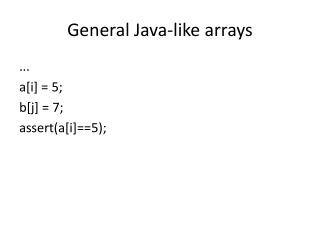
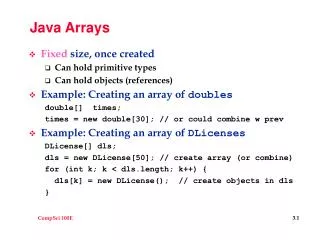
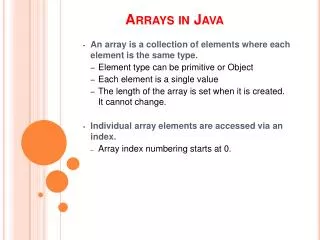
General Java-like arrays ... a[i] = 5; b[j] = 7; assert(a[i]==5);
All Arrays of Given Result Become One ClassArray Assignment Updates Given Array at Given Index length : Array -> int data : Array -> (Int -> Int) or simply: Array x Int -> Int a.data[i] = x data= data( (a,i):= x) class Array { int length; data : int[]} a[i] = x
Assignments to Java arrays: Now including All Assertions(safety ensured, or your models back) length : Array -> int data : Array -> (Int -> Int) or simply: Array x Int -> Int • assertassert data= data( (a,i):= x) class Array { int length; data : int[]} a[i] = x y = a[i]
Variables in C and Assembly Can this assertion fail in C++ (or Pascal)? x= 4; y= 5; assert(x==4); void funny(int& x, int& y) { } int z; funny(z, z);
Memory Model in C Just one global array of locations: mem: int int // one big array each variable x has address in memory, xAddr, which is &x We map operations to operations on this array: int x; int y; int* p; y= x mem[yAddr]= mem[xAddr] x=y+z mem[xAddr]= mem[yAddr] + mem[zAddr] y = *p mem[yAddr]= mem[mem[pAddr]] p = &x mem[pAddr] = xAddr *p = x mem[mem[pAddr]]= mem[xAddr]
Variables in C and Assembly Can this assertion fail in C++ (or Pascal)? • void funny(int& x, int& y) { • x= 4; • y= 5; • assert(x==4); • } • int z; • funny(&z, &z); • void funny(xAddr, yAddr) { • mem[xAddr]= 4; • mem[yAddr]= 5; • assert(mem[xAddr]==4); • } • zAddr = someNiceLocation • funny(zAddr, zAddr);
Disadvantage of Global Array In Java: wp(x=E, y > 0) = In C: wp(x=E, y > 0) =
Disadvantage of Global Array In Java: wp(x=E, y > 0) = y > 0 In C: wp(x=E, y > 0) = wp(mem[xAddr]=E’, mem[yAddr]>0) = wp(mem= mem(xAddr:=E’), mem(yAddr)>0) = (mem(yAddr)>0)[ mem:=mem(xAddr:=E’) ] = (mem(xAddr:=E’))(yAddr) > 0 Each assignment can interfere with each value! This is a problem with the language, not our model
New Objects Point Nowhere class C { int f; C next; C prev; } this should work: x = new C(); assert(x.f==0 && c.next==null && c.prev==null) x = new C();
If you are new, you are known by few class C { int f; C next; C prev; } Assume C is the only class in the program Lonely object: no other object points to it. Newly allocated objects are lonely! x = new C();
Remember our Model of Java Arrays length : Array -> int data : Array -> (Int -> Int) or simply: Array x Int -> Int • assertassert data= data( (a,i):= x) class Array { int length; data : int[]} a[i] = x y = a[i]
Allocating New Array of Objects class oArray{ int length; data : Object[]} x = new oArray[100]
Procedure Contracts Suppose there are fields and variables f1,f2,f3 (denoted f) procedure foo(x): requires P(x,f) modifies f3 ensures Q(x,old(f),f) foo(E) assert(P(E,f)); old_f = f; havoc(f3); assume Q(E,old_f, f)
Modification of Objects Suppose there are fields and variables f1,f2,f3 (denoted f) procedure foo(x): requires P(x,f) modifies x.f3 ensures Q(x,f,f’) foo(E) assert(P(E,f)); old_f = f; havoc(x.f3); havoc(f3); assume assume Q(E,old_f, f)
Example class Pair { Object first; Object second; } void printPair(p : Pair) { ... } void printBoth(x : Object, y : Object) modifies first, second // ?{ Pair p = new Pair();p.first = x;p.second = y;printPair(p);}
Allowing Modification of Fresh Objects Suppose there are fields and variables f1,f2,f3 (denoted f) procedure foo(x): requires P(x,f) modifies x.f3 ensures Q(x,f,f’) foo(E) assert(P(E,f)); old_f = f; havoc assume assume Q(E,old_f, f) Data remains same if: 1) existed and 2) not listed in m.clause
![Java Arrays [Lists] in 10 Minutes](https://cdn3.slideserve.com/5636194/java-arrays-lists-in-10-minutes-dt.jpg)