Exploring Medieval and Renaissance Masterpieces: Technique, Subject, and Realism
This overview examines notable works from the Medieval and Renaissance periods, focusing on artists like Berlinghiero, Giotto, and Leonardo da Vinci. Key aspects include their techniques, such as tempera on wood and oil on canvas, as well as their dedication to realism and attention to detail. The influence of classical themes and the goal of each painting, whether to convey religious significance or capture human emotion, is analyzed across pieces like the Madonna and Child and The Last Supper. Discover how these masterpieces shaped art history.

Exploring Medieval and Renaissance Masterpieces: Technique, Subject, and Realism
E N D
Presentation Transcript
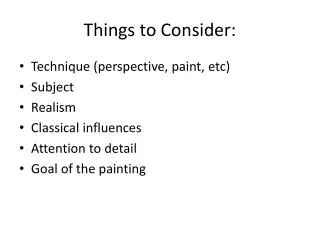
Things to Consider: • Technique (perspective, paint, etc) • Subject • Realism • Classical influences • Attention to detail • Goal of the painting
Madonna and Child Berlinghiero (Italian, Lucca, active by 1228, died by 1236)Tempera on wood, gold ground
The Epiphany possibly ca. 1320Giotto diBondone (Italian, Florentine, 1266/76–1337)Tempera on wood, gold ground
The Crucifixion 1340sPietro Lorenzetti (Italian, Sienese, active 1320–44)Tempera on wood, gold ground, with original engaged frame
The Last Supper Leonardo da Vinci1498
Sistine Chapel Michelangelo 1508-1512
The Alba Madonna Raphael Santi1511Oil on canvas
The School of Athens Raphael Santi1509-10
The Mona Lisa Leonardo da Vinci, 1503-07.
Pallas Athena and the Centaur Botticelli, c.1481.
A Young Hare Durer1502; Watercolor and gouache on paper
Self-Portrait at 26 Durer1498; Oil on panel,
Arnolfini Wedding Jan van Eyck, 1434
Henry VIII 1534; Henry Holbein
The Wedding Dance Brueghel; c. 1566
Madonna and Chancellor Rolin Jan van Eyck, c. 1435 Oil on panel
The Merode Altarpiece (c.1425),by Robert Campin