Ant Colony Optimization
Ryan Ward. Ant Colony Optimization. Overview. Ant Colony Optimization (ACO) uses ants finding food as inspiration for algorithms to find near optimal solutions to computationally intensive problems

Ant Colony Optimization
E N D
Presentation Transcript
Ryan Ward Ant Colony Optimization
Overview • Ant Colony Optimization (ACO) uses ants finding food as inspiration for algorithms to find near optimal solutions to computationally intensive problems • Has been applied to multiple NP problems such as the Traveling Salesman Problem, Job-Shop Scheduling Problem, and the Quadratic Assignment Problem
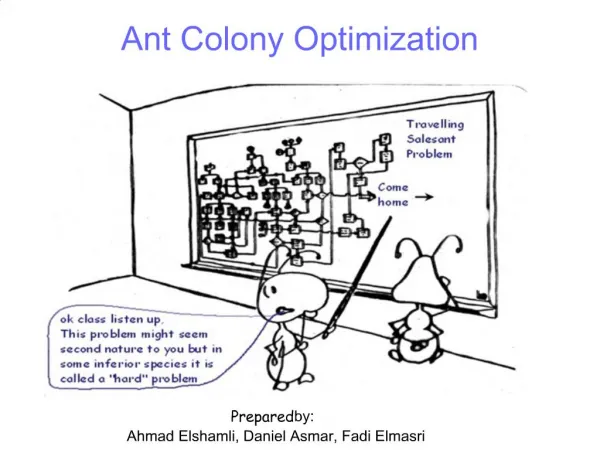
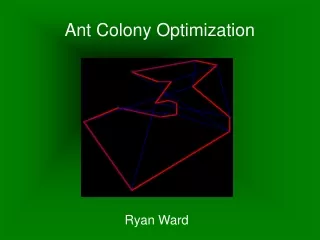
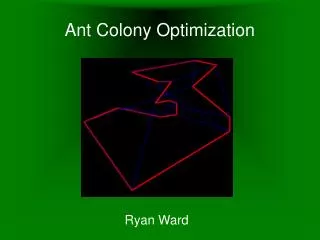
Traveling Salesman Problem • Given n nodes on a graph, find the circuit that visits all the nodes with the lowest cost • 2D Euclidean Symmetric
Natural Ant System • Initially, ants explore randomly • Leave behind pheromone when they travel back to colony from food • Pheromone evaporates over time • Ants follow strong pheromone left behind by other ants • Short routes to food have more pheromone (less distance = less evaporation)
Consequences of Natural System • Independent agents communicating to each other by effecting the environment • Agents act independently by exploring solution space early, then together by converging on and exploring good solutions • Continuously updating and changing solution (partial on-line algorithm)
Create n agents, initialize cost and pheromone matrices • While end conditions are not met • agents create circuits, deciding where to go at each step depending on cost and pheromone • update pheromone • Pheromone updating can be done in multiple ways: • All ants add pheromone to their best route • The ant(s) with the best route adds pheromone
Exploration vs. Exploitation • Pheromone vs. known cost • Evaporation • Pheromone added by ants is a function of distance • Pheromone subtracted after move • How ants add pheromone
Comparisons to Other Algorithms • Performs at near the same time and effectiveness as GA, TS, SA • Since it involves agents, can be multi-threaded • Biggest advantage comes when applied to dynamic problems
Dynamic TSP • Set of nodes changes over time • Learned information (pheromone) may become obsolete after changes • Necessary to modify pheromone values after a change in the problem to keep useful pheromone while removing obsolete pheromone • Reset method, distance-based method
Research • Examined reset and distance-based methods for varying frequencies and severities of changes • Reset for low frequency and large changes • Distance-based for high frequency and small changes
QAP • Assignment problem • Related to TSP • Locations, flows, and costs between locations • Pheromone links locations to certain assignments • More complex