Download
1 / 19
210 likes | 357 Vues
This article explores the multifaceted challenges of teaching language immersion programs in Edmonton Public Schools. Drawing from teacher, principal, and consultant perspectives, it identifies key issues such as resource availability, student engagement, and teacher language proficiency. The insights gathered from informal surveys highlight the importance of inclusive practices, effective pedagogical approaches, and maintaining high standards across the curriculum. The piece discusses strategies implemented to enhance program quality and student achievement, emphasizing the successful adaptation of language immersion models across various languages and contexts.

E N D
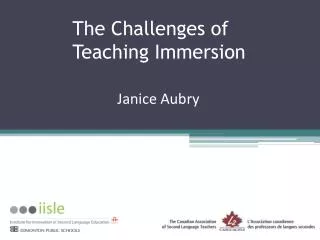
The Challenges of Teaching Immersion Janice Aubry
BACKGROUND/PERSPECTIVES • CASLT • IISLE at Edmonton Public Schools • SLIC • Confucius Institute in Edmonton • Cervantes Institute Associated Centre • (Teacher, Consultant, Administrator) • (University Instructor of Preservice Teachers) • (Team Leader Languages at Alberta Education)
CONTEXT:EDMONTON PUBLIC SCHOOLS • 79,539 students (K-12) • 197 schools • Alternative programs since 1974 • 13 languages • L2 study required Grades 4-9* • 40,610 students studying a language in addition to English • 12, 621 EAL/ESL/ELL • “Enabling” provincial language policy • Partnerships: China, Spain, Germany, France…etc.
LOTE ENROLMENTS: 40,610 • French Immersion Programs: 3130 • Bilingual (Partial Immersion) Programs: 3914 • Extended Cree Program: 72 • French as a Second Language (FSL): 27,371 • International Language and Culture: 5370 • Aboriginal Language and Culture (Cree): 531 • Signed Language and Culture (ASL): 222
IMMERSION AND BILINGUAL (PARTIAL IMMERSION) PROGRAMS • French Immersion • Early: 3037 • Late: 93 • Extended Cree: 72 • Bilingual (Partial Immersion) • Arabic: 927 • ASL (American Sign Language): 46 • Chinese (Mandarin): 1760* • German: 583 • Hebrew: 119 • Spanish: 271* • Ukrainian: 162
WHAT ARE THE CHALLENGES OF TEACHING IMMERSION? THOUGHTS FROM A SCHOOL DISTRICT
PERSPECTIVES:WHAT IS THE BIGGEST CHALLENGE? • Teachers • Principals • Immersion/Partial Immersion Teacher Consultants • My thoughts! • Informal Survey…..“conversations”
TEACHERS’ THOUGHTS (27) • Resources (12) • Students engagement/valuing L2 (5) • Meeting diverse student needs (5) • Instructional time to teach “all” (2) • Teaching content effectively (1) • Teacher language proficiency (1) • Ensuring parent support (1)
PRINCIPALS’ THOUGHTS (13) • Supervision/support for teachers (4) • Pedagogy (3) • Inclusive ed./meeting diverse student needs (2) • Maintaining a school community (1) • Teacher language proficiency (1) • Instructional time (1) • Targets – What is a successful program? (1)
CONSULTANTS’ THOUGHTS (3) • Ensuring teachers maintain target language exclusively (2) • Teacher pedagogy (1)
MY PERSPECTIVE: CHALLENGES Classroom level: • Ensuring meaningful, relevant, engaging approaches to produce engaged, functional students
MY PERSPECTIVE: CHALLENGES Classroom level: • Ensuring effective and welcoming inclusive classrooms (for example, ensuring good support/interventions for students of diverse needs across our range of languages)
MY PERSPECTIVE: CHALLENGES Classroom level: [Technologies….] distracters versus effective integration of technologies - to have a measurable impact on improving student achievement
MY PERSPECTIVE: CHALLENGES Systemic Level: • Impact of baby boom: • Volume of new teachers and principals • Teachers: proficiency, pedagogy, knowledge of model • Principals: Standards, supervision, continuous improvement in achievement, quality
MY PERSPECTIVE: CHALLENGES Systemic Level: Ensuring ongoing, continuously improving, consistent ,quality programming across the system that ensures excellent student achievement Standards, measures Leadership and teachers training Program alignment Etc.
STRATEGIES ARE IN PLACE Examples: • Strategic Plans with concrete activities, such as: • Resourcing: • Resource acquisition ,development, Centres • Inclusive education: • Consultant support, modules, lit reviews, symposium • Technologies: • Research/lit reviews, technologies playground, training • Literacy • Interventions research and programs • Leadership/capacity development • Leadership Sessions, Institutes, Networks, Courses • Quality Standards, tools, training …..AND MORE!
CLOSING THOUGHTS… • The successful Canadian French Immersion model was adapted to other languages in the prairie provinces beginning in the late 1970’s, with great and increasing success • Today, this model is used throughout the world in many countries, with expanding momentum and great success • Dr. Lambert and his team were foundational contributors to this movement.