Download

1 / 15
150 likes | 267 Vues
The story of Belshazzar's feast in Daniel 5 serves as a powerful reminder of pride and idolatry. Following the reign of Nebuchadnezzar, Belshazzar, the King of Babylon, throws a lavish feast using sacred vessels from the Jerusalem temple, demonstrating irreverence toward God. A mysterious hand appears, writing "Mene, Mene, Tekel, Upharsin," leading to fear and confusion among the guests. Daniel, called to interpret the message, reveals God's judgment against Belshazzar for his arrogance and sacrilege. This tale underscores the importance of acknowledging God's authority and avoiding the pitfalls of materialism.

E N D
The Handwriting on the Wall Daniel 5
Introduction • Nebuchadnezzar died in 562 BC after ruling for 43 years • His son, Evil-Merodach, succeeded 2Kgs 25:27 • After two years he was assassinated by Nergilissar, his brother-in-law (560 BC) • Nergilissar in turn died four years later (556 BC), leaving the throne to his infant son, Labashi-Marduk • 9 months later the priests lead a revolt and kill Labashi-Marduk • Nabonidus, the son of a priestess, is made king
Nabonidus • Nabonidus may have been a priest of the moon god, like his mother • After ruling 3 years, he appoints his son, Belshazzar, as co-regent • Nabonidus goes to the city of Tayma, a site of moon worship, and remains there 10 years • In 540 BC he returns to gather an army to defend against a Persian army • In 539 BC Nabonidus takes the army to set up a defensive line or perhaps to attack the Persian invaders • Belshazzar is still left as king in Babylon charged with the defense of the city
The Feast • Dan 5:1-3 • Belshazzar throws a big feast • By the Babylonian calendar, this may have been in honor of Shammash, the god of justice • Or may be a celebration of expected victory of Nabonidus over Cyrus, the Persian • Nebuchadnezzar had taken gold and silver vessels from the temple in Jerusalem 2 Chr 36:10 • Nebuchadnezzar not his literal “father” • Either in the meaning of “predecessor” • Or perhaps he or his father married Nebuchadnezzar’s daughter or a granddaughter • Or perhaps a “political lie” • Belshazzar uses the vessels in the feast • Perhaps thinking it is a reminder of previous Babylonian victories
The Feast • Dan 5:4 • They “praised the gods of gold and silver, bronze and iron, wood and stone” • The king and guests foolishly praised the creation rather than the Creator • Probably thanking their “gods” for the past victory over Israel and their hoped for future victory over Persia • Either felt the battle was already over or would be the next day • Both armies were deployed for battle a couple days journey away from Babylon
Application • Would we ever stoop so low? • Worship the gods of silver and gold? • Become guilty of idolatry? • We do if we are covetous! • Eph 5:5; Col 3:5 • Making mammon (material riches) our god (Mt 6:24) • Making created things the prime focus of our time and interest
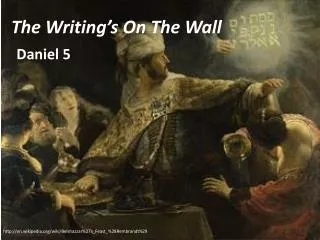
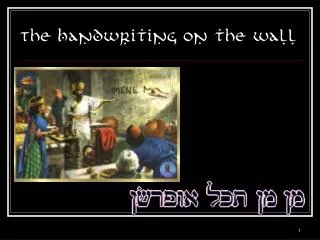
The hand writing on the wall • Dan 5:5-6 • The fingers of a hand appears and write on a wall where the light is shining • Whether the writing is like charcoal on the plaster • Or like Babylonian writing, carved into the plaster wall, is unknown • The king sees the hand writing and . . . • “countenance changed” lit. “cheerfulness frustrated” • “thoughts troubled him” lit. “thoughts terrified him” • “his loins were loosed” (KJV) euph. “wet himself” • “his knees knocked against each other”
Looking for an explanation • Dan 5:7-9 • Calls for the wise men, etc and asks for an interpretation • Offers great rewards, including the third highest position in the kingdom • Belshazzar is only in the second position himself behind his father • The wise men can’t even read the writing, so they can offer no interpretation • Now the king is even more terrified and even less cheerful
Looking for an explanation • Dan 5:10-12 • The queen could be Belshazzar’s wife • Could be his mother or grandmother • Could be the wife of one of the previous kings (which would include Nebuchadnezzar’s daughter, if she is still alive) • Queen uses language like Nebuchadnezzar’s to describe Daniel and his God • Queen also seems to rub the “your father Nebuchadnezzar” in the king’s face • Makes sense if she is a descendant of Nebuchadnezzar and is pointing out how unlike him the king is
Daniel • Dan 5:13-16 • Daniel brought in • Apparently lost his position during all the changes of government • 70+ years old now, quite likely around 80 • King pretends to know all about Daniel • Even though he only knows what the queen just told him (or perhaps her words reminded him of things he had been told) • Perhaps hoping to flatter Daniel to get a good interpretation • Also offers the same reward • Would return Daniel to a high (even higher) position
Reminders • Dan 5:17-23 • Daniel not interested in gifts and rewards • Unlike the king he does not worship the creation • Tells the king what happened to Nebuchadnezzar when he became too proud • How Nebuchadnezzar finally acknowledged that God ruled over the kingdoms of men • Belshazzar has insulted the God who holds his life in His hands • By defiling the vessels from His temple • By praising idols at the same time
The Interpretation • Dan 5:24-28 • "Mene, Mene, Tekel, Upharsin" • Lit. “Numbered, numbered, weighed, divided” • Even though the words were Chaldean, since the wise men couldn’t read them, probably written with Hebrew letters • MENE – God numbered the length of the Babylonian kingdom – Time’s up! • TEKEL – God weighed Belshazzar as a king – He doesn’t measure up to what a king should be • UPHARSIN – (PERES is the singular) – God has divided (broken) the kingdom and given it to the Medes and Persians
The Results • Dan 5:29-31 • Daniel is given the offered rewards • Short-lived though they were • That night, Babylon fell to Cyrus • While Nabonidus waited for battle across from the main Persian army • Cyrus sent a small army around the Babylonians under his general Darius the Mede • He used slaves to cut a channel diverting the river which flowed beneath the walls of Babylon • Allowed his small army to enter beneath the walls and capture Babylon without a fight (only Belshazzar was slain) - October 12, 539 BC • Nabonidus later surrendered
Conclusion • Luke 12:15-21 • How quickly the proud and boastful can fall, despite power and wealth • One day a proud, boastful king • The next a dead man • Sooner or later, everyone will face God’s judgment • Are you prepared?