Key Economic Theorists: From Adam Smith to Karl Marx
This overview highlights the contributions of significant economic theorists from the 18th and 19th centuries, including Adam Smith, who established the framework for free market economics, and Thomas Malthus, who warned of population growth outpacing food supply. David Ricardo introduced the Iron Law of Wages, while Karl Marx's revolutionary ideas shaped modern economic and social thought. Jeremy Bentham's utilitarianism emphasized the greatest good for the greatest number, and Robert Owen demonstrated the potential of cooperative factories through his model at New Lanark Mills.
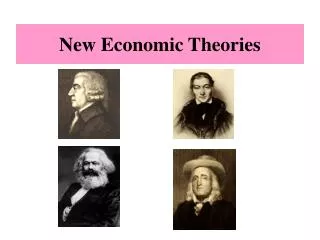

Key Economic Theorists: From Adam Smith to Karl Marx
E N D
Presentation Transcript
Adam Smith1723–1790 AdamSmith laid the intellectual framework for the concept of the free market
Thomas Malthus 1766–1834 In An Essay on the Principle of Population (1798), Malthus predicted that the food supply would not meet the needs of the growing population
David Ricardo 1772–1823 The “Iron Law of Wages”
Karl Marx 1818–1883 Philosopher, social scientist, historian and revolutionary, Karl Marx is regarded by many as the most influential economic and social thinker of the 19th century
Jeremy Bentham 1748–1832 Utilitarianism: “The greatest good for the most people” or “The greatest good over the least pain”
Robert Owen1771–1858 • Utopian socialist • Founded New Lanark Mills in Scotland as a model cooperative factory • Many industrialists visited New Lanark, and a few adopted aspects of Owen’s cooperative