Download
1 / 8
80 likes | 191 Vues
This overview highlights key Supreme Court cases that have significantly influenced federalism and civil rights in the United States. Notable cases include Marbury v. Madison, which established judicial review, and McCulloch v. Maryland, affirming federal powers. Civil rights cases such as Brown v. Board of Education overturned previous discrimination laws, ensuring equality in education. The impact of cases regarding personal freedoms, such as Roe v. Wade and Miranda v. Arizona, showcases the evolution of rights. Understanding these rulings is essential to grasping contemporary legal principles.

E N D
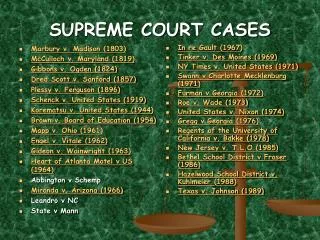
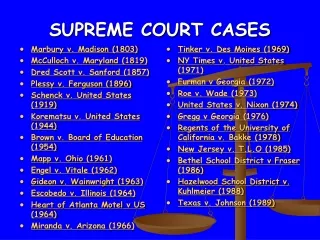
Cases on Federalism • Marbury v. Madison (1803): judicial review, strong S.C. • McCulloch v. Maryland (1819): court has implied powers, necessary and proper clause, expands power of fed gov’t • Ableman v. Booth (1859): state courts can not contradict fed courts • US v. Nixon (1974): President is not above the law
Cases on Discrimination, Race • Dred Scott v. Sandford (1857): Blacks, free or slave, are not citizens; slavery can not be outlawed in w territories • Plessy v. Ferguson (1896): segregated facilities are okayseparate but equal • Korematsu v. US (1944): Americans of Japanese descent can be interned • Brown v. Board of Education (1954) segregated schools violate 14th amend. Overturns Plessy • Regents of UC v. Bakke (1978) race-based set asides violate Equal Protection Clause. Some race usage may be employed in admission decisions
Birth Control and Abortion • Griswold c. Connecticut (1965) married couples are entitled to contraception. Establishes right to privacy • Roe v. Wade (1973) abortion is a constitutional right, thus prohibitions against it in the 1st tri are prohibited • Planned Parenthood v. Casey (1992) Restrictions on abortion are allowed, though it affirms Roe • Gonzales v. Carhart (2007) Congress can prohibit a specific abortion procedure
Search and Seizure • Mapp v. Ohio (1961) evidence gained by search/seizure that violates Const, is inadmissible in court • Katz v. US (1967) evidence from the wiretapping of a public phone w/o a warrant is inadmissible • Vemonia School District v. Acton (1995) schools may implement random drug testing
Right to an Attorney • Gideon v. Wainwright (1963) those charged w/ a serious offense are entitled to an attorney and state must pay • Escobedo v. Illinois (1964) person in police custody has a right to speak to an atty • Miranda v. Arizona (1966) Police must advise people of their right to remain silent, to have an atty. Interrogation must stops if suspect wishes to remain silence • In re Gualt (1967) Juveniles charged w/ a crime are protected by due process
Freedom of Speech • Schenck v. US (1919) “Clear and Present Danger” speech is not protected by the 1st amend • Near v. Minnesota (1931) Rejects prior restraints on publishing, censorships is unconstitutional except in rare situations • Chaplinsky v. NH (1942) established the ‘fighting words doctrine: that some words are not protected by 1st amendment • Tinker v. Des Moines schools (1969) Wearing armbands is a legitimate form of protest, even on school grounds
Other Landmark Cases • Fletcher v. Peck (1810) 1st time SC struck down a state law as unconstitutional • Dartmouth College v. Woodward (1819) extended contract rights to corporations • Gibbons v. Ogden (18240 Power to regulate interstate commerce is granted to Congress