Paying for Reform
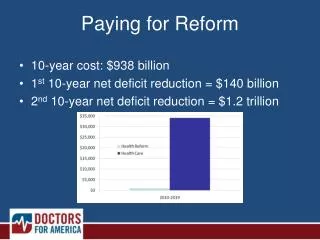
The Affordable Care Act (ACA) leads to significant financial changes in healthcare, with a projected 10-year cost of $938 billion, coupled with a $140 billion net deficit reduction in the first decade, escalating to $1.2 trillion in the second. Key funding sources include increased taxes on industries and higher-income individuals, alongside the introduction of the "Cadillac Tax" and a tanning tax. The ACA enhances benefits for seniors and the disabled, reduces Medicare reimbursements to lower-quality providers, and incentivizes improved hospital care while decreasing subsidies for private insurance companies.

Paying for Reform
E N D
Presentation Transcript
Paying for Reform • 10-year cost: $938 billion • 1st 10-year net deficit reduction = $140 billion • 2nd 10-year net deficit reduction = $1.2 trillion
Paying for Reform Taxes • Industry (insurance, pharmaceutical, medical devices) • On individuals • Payroll: additional 0.9% Medicare payroll take on wages >$250,000 (couple), >$200,000 (individual) • Capital gains: 3.8% tax on unearned income (interest, dividends) >$250,000 • “Cadillac Tax”: insurance plans >$27,500 (family) and >$10,200 (individual) taxed starting in 2018 • Tanning tax 10%
Medicare is saving $716 Billion. Bottom Line: The ACA increases benefits for seniors and the disabled. • Medicare reimbursements rise at a lower rate, and lower quality providers are reimbursed less ($415B) • Less uncompensated care (more people with insurance) means Medicare could slow the rate of growth of reimbursements. • Hospitals have a financial incentive to improve care. • Medicare subsidies to private insurance companies are decreased to equal what we spend to take care of straight Medicare patients ($156B)
Medicare is saving $716 Billion. Bottom Line: The ACA increases benefits for seniors and the disabled. • Medicare pays lower subsidies to hospitals that were taking care of uninsured patients, now that many will be insured ($56B) • All other, including enhanced fraud prevention ($89B)