Download
1 / 12
120 likes | 227 Vues
This guide introduces the order of operations, an essential concept for evaluating numerical expressions correctly. Key terms like PEMDAS (Parentheses, Exponents, Multiplication, Division, Addition, Subtraction) are explained. You'll learn how to structure and simplify mathematical phrases with clarity and precision. Through various examples and exercises, you'll practice evaluating expressions such as 9 + 12 * 2 and 4 * 32 + 8 - 16. Engage in pair activities and challenge yourself to master the order of operations!

E N D
Warm Up 1) 8 + 4 - 2 2) 9 x 3 + 1 3) 7 - 3 + 5 4) 20 ÷ 4 + 6
- + Order of Operations What do we know? x ÷
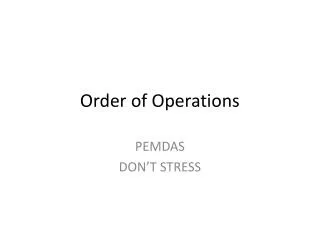
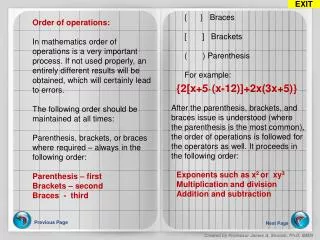
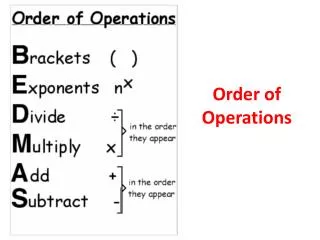
Multiplication Parentheses PEMDAS Addition Exponents Subtracting Division
Important Terms • A mathematical phrase that contains only numbers and operations is called a numerical expression. • To evaluate a numerical expression, you find its value. • You can use the order of operations to evaluate a numerical expression.
Evaluate each expression. A. 9 + 12 * 2
Evaluate B. 4* 32 +8 -16
Evaluate C. 8 ÷ (1 + 3) * 52 - 2
NOW IT’S YOUR TURN! A) 15 – 10 ÷ 2 B) 8 + 14 ÷ 2 +6 * 32 C) 3 + (4 + 7) + 22
IN PAIRS! 5 * 3 +8 * 2 15 + 16 31
Closure: How would I evaluate this numerical expression? 5 – 6 ÷ 2 + 10 * 4