
stereocenter
This study focuses on the kinetic assay of fumarase, an enzyme that catalyzes the conversion of fumarate to malate. We explore the reaction rate, rate enhancement, and the effects of various factors such as protein concentration, pH, and temperature on enzyme activity. The assay employs UV absorbance to monitor changes in reactant and product concentrations over time, allowing us to quantify the reaction rate. Optimization of conditions is key to accurately determining the enzyme's performance and understanding its catalytic mechanism.
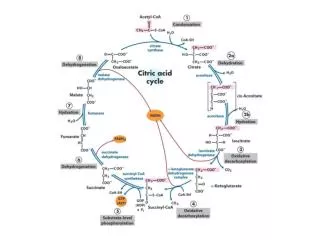

stereocenter
E N D
Presentation Transcript
Enzyme kinetic assay • How fast does the reaction occur? • How good of a catalyst is fumarase? • Rate enhancement? • What factors influence the enzyme activity? • Amount of protein, pH, temperature, concentration of substrate/product, etc. • Need an assay appropriate to the reaction being considered.
Bradford assay • Spectral properties of the dye change when bound to protein • More protein: more dye molecules in ‘bound’ form
Fumarase assay • Spectral properties of the chemical change reactant (fumarase) vs. product (malate) • Fumarase absorbs ultraviolet light • Carbon-carbon double bond • Malate “doesn’t” • “Follow” the reaction according to the UV absorbance of the reaction solution
Follow the reaction • At the start: • 100% fumarate • High absorbance • At the end: • Mostly malate • Low absorbance • DAbs/time directly proportional to D[fumarase]/time Absorbance (l=260nm) Time (seconds)
Rate of reaction • How fast does substrate disappear/product appear? • Units: “#molecules/time” • Absorbance depends on concentration: • Determine mM/min • Concentration depends on volume • Calculate mmol/min • More enzyme = faster reaction: normalize to amount of enzyme • Calculate mmol/min/mg
Fumarase is a catalyst • How does its catalysis depend on pH (quantitatively) • Learn about the mechanism of catalysis • Identify optimal conditions to measure other variables • ie. optimize pH while you measure effects of temperature, [substrate], etc. • Learn about biology
The actual experiment • Mix fumarase (enzyme) with fumarate (sugar/substrate) in a quartz cuvette • Start the reaction! • *Quickly* put cuvette in spec • Spec’s ‘kinetic mode’ measures Dabs/time • Determine initial rate
Absorbance Time
A base in the active site is required to ‘activate’ water*improve its nucleophile character*
Optimum pH • Determine rate (mmol/min/mg) at 4,5,6,7,8,9,10,11 • Buffers provided • ‘rough’ pH optimum • Make 3 or 4 more buffers to refine the pH optimum
Things to think about • How will you make 18 mM sodium phosphate at pH x? • How do you convert change in absorbance over time to change in fumarate (in mmol) over time?
