Download
1 / 7
70 likes | 174 Vues
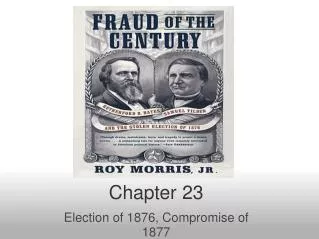
The 1876 Presidential election was one of the closest in U.S. history, pitting Republican Rutherford B. Hayes against Democrat Samuel J. Tilden. Tilden won the popular vote and was just one electoral vote shy of victory, leading to disputes over questionable votes in several states. The election stalemate prompted the Compromise of 1877, which resulted in Hayes's presidency in exchange for the withdrawal of military forces from the South, effectively ending Reconstruction and igniting the Jim Crow era. This pivotal moment influenced civil rights and race relations for decades.

E N D
Chapter 23 Election of 1876, Compromise of 1877
Election of 1876 "Some are born great, some achieve greatness, and some are born in Ohio..." –Trying to gain the swing votes from Ohio (Rutherford Hayes) •Candidates: –Republicans: Rutherford B. Hayes –Democrats: Samuel J. Tilden
Problem with Election •Election was extremely close, with Tilden one electoral vote away from winning, had won popular vote •There 20 questionable votes that could go either way, Tilden needed only one to win •Both sides went to the questionable states (LA, SC, FL, OR) to gain votes –Required a recount; depending on which branch of congress counted, would determine which side won the election (Democratic House, Republican Senate) •Election was at a stalemate
Compromise of 1877 •Passed Electoral Count Act –15 men (from House, Senate & Supreme Court); 7 Democrats, 8 Republicans •Democrats angry b/c Republicans had an advantage and were heading towards victory •The Compromise was made –North/Republicans: Rutherford B. Hayes elected –South/Democrats: removal of military occupation in south (end of reconstruction) •Freed blacks left without protection, Civil Rights Act was ignored –Money would be spent on Texas and Pacific railroad
Jim Crow Laws Also known as the black codes these were harsh rules that were established to restict blacks rights.
Civil Rights Act -Strongly ignored after reconstruction ended -Advocated in the North -Black were in favor -Southerners hated it