Download
1 / 11
110 likes | 293 Vues
This guide explores the fundamental aspects of chemical reactions, focusing on the evidence indicative of a chemical change, such as color changes, odor, gas bubbles, and precipitate formation. Through a detailed examination of temperature changes, students learn to balance chemical equations effectively, including skeletal and balanced forms. By understanding these concepts, learners can gain insights into the intricacies of chemical transformations, practical applications, and the importance of proper formula usage in balancing equations.

E N D
Temperature change 100.1 Evidence of Chemical Change http://gallery.hd.org/_c/natural-science/_more1999/_more05/ice-melts-at-0C-electronic-thermometer-glass-beaker-liquid-water-ice-cubes-melting-probe-in-water-white-backdrop-2-AJHD.jpg.html?sessionVar=spider&sessionVarLiteUI=true&sessionVarLocale=en_GB
COLOR CHANGE Evidence of Chemical Change
ODOR Evidence of Chemical Change http://pubs.acs.org/cen/newscripts/86/8626newscripts.html
Gas Bubbles Evidence of Chemical Change
A solid forms Precipitate Evidence of Chemical Change http://www.chem.uiuc.edu/webFunChem/grammoleprob/GramMoleProb3.htm http://year9reaction.wordpress.com/precipitation/
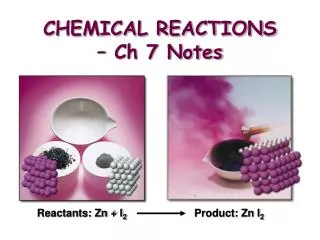
Word Equation Solid sodium reacts with water to produce sodium hydroxide and hydrogen gas • Skeletal Na+H2O NaOH + H2 Chemical Equations
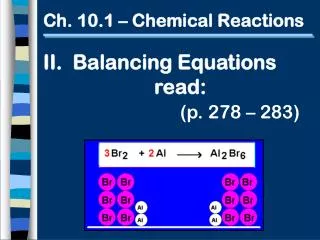
Balanced 2Na+2H2O 2NaOH + H2 Skeletal Na+H2O NaOH + H2 Balanced Chemical Equations
Write Skeletal Equation • Be sure to use proper formulas • Count atoms of each element in reactants • Remember diatomics H2, O2, N2, F2, Br2, Cl2, I2 • Count atoms of each element in products • Change coefficients to balance the number of each element in reactants and products • Make sure coefficients are in lowest possible ratioFlow chart on pg 283 Balancing Chemical Equations