Download
1 / 9
90 likes | 201 Vues
Delve into the intricate web of deceit, madness, and hidden motives in Shakespeare's iconic tragedy "Hamlet." Explore the characters' struggles with truth, reason, and sanity as they navigate through a world of deception and ambiguity. Discover the timeless themes of vengeance, deception, and existential questioning in this captivating play that continues to resonate with audiences today.

E N D
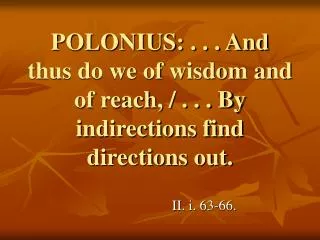
POLONIUS: . . . And thus do we of wisdom and of reach, / . . . By indirections find directions out. II. i. 63-66.
QUEEN: More matter, with less art. II. ii. 96.
POLONIUS: . . . That he’s mad, ‘tis true. ‘Tis true, ‘tis pity, / And pity ‘tis ‘tis true—a foolish figure. / But farewell it; . . . And now remains / That we find out the cause of this defect, / For this effect defective comes by cause. II. ii. 98-104.
POLONIUS: (aside) Though this be madness, yet there / is method in’t. II. Ii. 205-06.
HAMLET: . . . For there is nothing / either good or bad but thinking makes it so. To me it is / a prison.ROSENCRANTZ: Why, then your ambition makes it one. ‘Tis too narrow for your mind. II. ii. 248-52.
HAMLET: . . . What a piece of work is a man, / how noble in reason, how infinite in faculties, in form / and moving how express and admirable, in action how / like an angel, in apprehension how like a god . . . . II. ii. 303-08.
HAMLET: I am but mad north-north-west. When the wind / is southerly, I know a hawk from a handsaw. II. ii. 377-78.
HAMLET: God’s bodkin, man, much better! Use every / man after his desert, and who shall ‘scape whipping? II. ii. 526-27.
HAMLET: . . . I am pigeon-livered and lack gall / To make oppression bitter, or ere this / I should ha’ fatted all the region kites / With this slave’s offal. Bloody, bawdy villain! II. ii. 574-77.