Unraveling the Link Between 4-Nonylphenol and Increased Breast Cancer Risk in Long Island
Breast cancer remains the most prevalent cancer affecting women, with Long Island showing alarming rates of incidence and mortality. Over 80% of breast cancer tumors are estrogen-activated, and Long Island has unique environmental exposure to 4-Nonylphenol (4-NP). This synthetic compound, prevalent since the 17th century due to farming activities, may mimic estrogen and influence gene expression in human immune cells. Our hypothesis posits that both 4-NP and estrogen share similar regulatory effects, highlighting the need to investigate external factors contributing to elevated breast cancer risks in the region.

Unraveling the Link Between 4-Nonylphenol and Increased Breast Cancer Risk in Long Island
E N D
Presentation Transcript
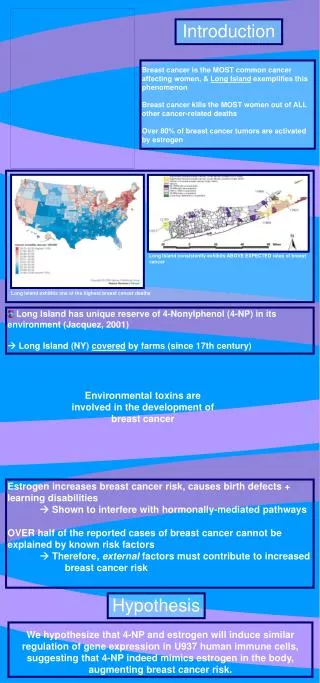
Introduction Breast cancer is the MOST common cancer affecting women, & Long Island exemplifies this phenomenon Breast cancer kills the MOST women out of ALL other cancer-related deaths Over 80% of breast cancer tumors are activated by estrogen Long Island consistently exhibits ABOVE EXPECTED rates of breast cancer Long Island exhibits one of the highest breast cancer deaths • Long Island has unique reserve of 4-Nonylphenol (4-NP) in its environment (Jacquez, 2001) • Long Island (NY) covered by farms (since 17th century) Environmental toxins are involved in the development of breast cancer Estrogen increases breast cancer risk, causes birth defects + learning disabilities Shown to interfere with hormonally-mediated pathways OVER half of the reported cases of breast cancer cannot be explained by known risk factors Therefore, external factors must contribute to increased breast cancer risk Hypothesis We hypothesize that 4-NP and estrogen will induce similar regulation of gene expression in U937 human immune cells, suggesting that 4-NP indeed mimics estrogen in the body, augmenting breast cancer risk.