The History of the Atom
Explore the pivotal discoveries in atomic structure as we delve into the contributions of renowned scientists. J.J. Thomson unveiled the electron through his cathode ray experiment, introducing the plum pudding model. Robert Millikan determined the charge-to-mass ratio of the electron via the oil drop experiment, revealing fundamental properties of electrons. Ernest Rutherford's gold foil experiment demonstrated an atom's vast emptiness and led to the identification of the nucleus, comprising protons and neutrons. This journey through atomic history highlights the essential roles these subatomic particles play in defining matter.

The History of the Atom
E N D
Presentation Transcript
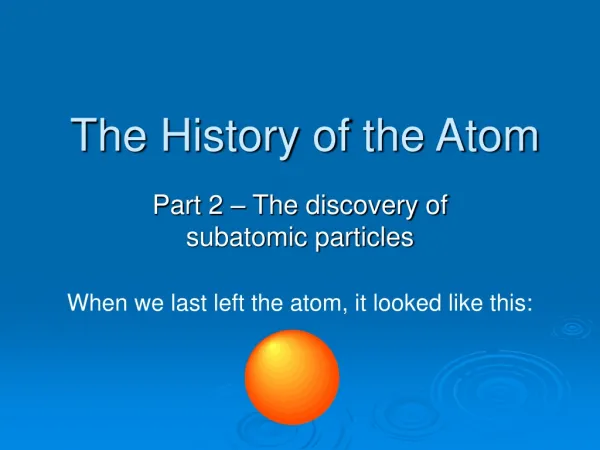
The History of the Atom Part 2 – The discovery of subatomic particles When we last left the atom, it looked like this:
J.J. Thomson • Discovered the electron with cathode ray experiment • Plum pudding model
Today’s Thomson Analogy • Chocolate Chip Cookie Chocolate chips are distributed throughout a cookie just as electrons are distributed throughout an atom
Cathode Ray that Thomson used showing how the electric beam is curved by the stream of electrons tube cathode Alligator clip anode stand Glass tube Thomson’s Experiment Video
Robert Millikan • An American • Discovered the charge/mass of the electron • Oil Drop Experiment
Oil Drop Experiment • Balanced the gravitational and electric forces on tiny charged droplets of oil suspended between two metal electrodes • By knowing the electric field, the charge on the oil droplet could be determined. • Repeating the experiment for many droplets, he found that the values measured were always multiples of the same number.
Smallest particle Almost no mass Negative charge Abbreviated e- Electron
Ernest Rutherford • Discovered that most of the atom is emptyspace using the gold foil experiment • Discovered the nucleus • Also given credit for coining the name proton
Rutherford’s model • Mostly empty space • Center area is the Nucleus • Little Blue dots are electrons
Rutherford Analogy • A peach A peach has a dense center known as the pit just like an atom has a dense but small center called the nucleus
James Chadwick Discovered the neutron in 1932
Neutrons Have no charge Are responsible for isotopes Roughly same mass as a proton Found in the nucleus Protons are Positive charged Define an element Has roughly same mass as a neutron Found in the nucleus Protons and Neutrons
Nucleus • Tiny dense region in the center of the atom • Over 99% of the mass of the atom found here. • Made of protons and neutrons AH Video Clip
Homework • Summarize the 9 scientists that we talked about the past 2 days on the Scientist Timeline Paper • You will not use all the blanks yet.