Semantic Communication at UCSD: Understanding the Meaning of Bits
Explore the challenges of effective communication between parties speaking different languages, particularly in the context of sending algorithms as instructions. Find out the limits and possibilities of achieving perfect communication and the importance of understanding the intended meaning beyond mere bit exchange. Discover computational motivations and goals in semantic communication scenarios. Delve into the implications and limitations of communication through formalized and generic approaches. Learn about successful universal communication theorems and their impacts on problem-solving capabilities. Critically analyze current approaches and look towards future enhancements for more efficient communication strategies.

Semantic Communication at UCSD: Understanding the Meaning of Bits
E N D
Presentation Transcript
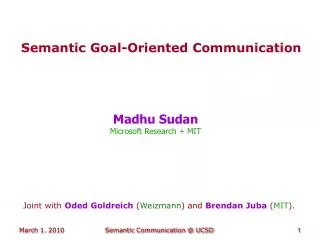
Semantic Goal-Oriented Communication MadhuSudan Microsoft Research + MIT Joint withOdedGoldreich(Weizmann)and Brendan Juba(MIT). Semantic Communication @ UCSD TexPoint fonts used in EMF. Read the TexPoint manual before you delete this box.: AAAA
Disclaimers Work in progress (for ever) … Feedback welcome. Interruptions welcome during the talk. … Alas, no algebra Semantic Communication @ UCSD
The Meaning of Bits Alice Channel Bob • Is this perfect communication? • What if Alice is trying to send instructions? • Aka, an algorithm • Does Bob understand the correct algorithm? • What if Alice and Bob speak in different (programming) languages? 01001011 01001011 Freeze! Bob Semantic Communication @ UCSD
Miscommunication (in practice) • Exchanging (powerpoint) slides. • Don’t render identically on different laptops. • Printing on new printer. • User needs to “learn” the new printer, even though printer is quite “intelligent”. • Many such examples … • In all cases, sending bits is insufficient. • Notion of meaning … intuitively clear. • But can it be formalized? • Specifically? Generically? • While conforming to our intuition Semantic Communication @ UCSD
Bits vs. their meaning • Say, Userand Serverknow different programming languages. Serverwishes to send an algorithm A to User. • A = sequence of bits … (relative to prog. language) • Bad News: Can’t be done • For every User, there exist algorithms A and A’, and Servers S and S’ such that SsendingAis indistinguishable (to User) from S’sending A’ • Good News: Need not be done. • From Bob’s perspective, ifA and A’ are indistinguishable, then they are equally useful to him. • What should be communicated? Why? Semantic Communication @ UCSD
Part I: Computational Motivation Semantic Communication @ UCSD
Computational Goal for Bob • Why does User want to learn algorithm? • Presumably to compute some function f (A is expected to compute this function.) • Lets focus on the function f. • Setting: • User is prob. poly time bounded. • Server is computationally unbounded, does not speak same language as User, but is “helpful”. • What kind of functions f? • E.g., uncomputable, PSPACE, NP, P? Semantic Communication @ UCSD
Setup Server User f(x) = 0/1? R Ã $$$ qk q1 a1 ak Different from interactions in cryptography/security: There, User does not trustServer, while here he does not understand her. Computes P(x,R,a1,…,ak) Hopefully P(x,…) = f(x)! Semantic Communication @ UCSD
Intelligence & Cooperation? • For User to have a non-trivial interaction, Server must be: • Intelligent: Capable of computing f(x). • Cooperative: Must communicate this to User. • Formally: • Server S is f-helpful if 9some (other) user U’ s.t. 8 x, starting states ¾ of the server (U’(x) $ S(¾)) outputs f(x) Semantic Communication @ UCSD
Successful universal communication • Universality: Universal User U should be able to talk to any (every) f-helpful server S to compute f. • Formally: • U is f-universal, if 8f-helpful S, 8¾, 8x (U(x) $ S(¾)) = f(x) (w.h.p.) • What happens if S is not helpful? • Paranoid view ) output “f(x)” or “?” • Benign view ) Don’t care (everyone is helpful) Semantic Communication @ UCSD
Main Theorems [Juba & S. ‘08] • If fis PSPACE-complete, then there exists a f-universal user who runs in probabilistic polynomial time. • Extends to checkable (“compIP”) problems • (NP Å co-NP, breaking cryptosystems) • S not helpful ) output is safe • Conversely, if there exists a f-universal user, then fis PSPACE-computable (in “compIP”) • Scope of computation by communication is limited by misunderstanding (alone). Semantic Communication @ UCSD
Proofs? • Positive result: • f Є PSPACE ) membership is verifiable. • User can make hypothesis about what the Server is saying, and use membership proof to be convinced answer is right, or hypothesis is wrong. Enumerate, till hypothesis is right. • Negative result: • In the absence of proofs, sufficiently rich class of users allow arbitrary initial behavior, including erroneous ones. • (Only leads to finitely many errors …) Semantic Communication @ UCSD
Implications • Communication is not unboundedly helpful • If it were, should have been able to solve every problem (not just (PSPACE) computable ones). • But there is gain in communication: • Can solve more complex problems than on one’s own, but not every such problem. • Resolving misunderstanding? Learning Language? • Formally No! No such guarantee. • Functionally Yes! If not, how can user solve such hard problems? Semantic Communication @ UCSD
Principal Criticisms Next part of talk • Solution is no good. • Enumerating hypotheses is too slow. • Approach distinguishes right/wrong; does not solve search problem. • Search problem needs new definitions to allow better efficiency. • Problem is not the right one. • Computation is not the goal of communication. Who wants to talk to a PSPACE-complete server? Semantic Communication @ UCSD
Part II: Generic Goals of Communication Semantic Communication @ UCSD TexPoint fonts used in EMF. Read the TexPoint manual before you delete this box.: AAAA
Alice Charlie Bob Dick F X F(X) Alice Charlie Bob Dick Aside: Communication? • Classical “Theory of Computing” • Issues: Time/Space on DFA? Turing machines? • Modern theory: • Issues: Reliability, Security, Privacy, Agreement? • If communication is so problematic, then why not “Just say NO!”? Semantic Communication @ UCSD
Communication: Example 1 (Printing) Semantic Communication @ UCSD
Communication: Ex. 2 (Computation) X f(X) Semantic Communication @ UCSD
Communication: Ex. 3 (Web search) WWW Q Q P Q(WWW(P)) = ? Semantic Communication @ UCSD
Communication: Ex. 4 (Intelligence?) Yes No Semantic Communication @ UCSD
Aside: Modelling Computing • Classically: Turing Machine/(von Neumann) RAM. • Described most computers being built? • Modern computers: more into communication than computing. • What is the mathematical model of a communicating computer? • What is universality? Semantic Communication @ UCSD
Communication: Ex. 2 (Computation) X f(X) Semantic Communication @ UCSD
Generic communication problem? Should model All 4 examples! WWW Q X f(X) Yes No Q P Q(WWW(P)) = ? Semantic Communication @ UCSD
Modelling User/Interacting agents User • (standard AI model) • User has state and input/output wires. • Defined by the map from current state and input signals to new state and output signals. Semantic Communication @ UCSD
Generic Goal? X X X User Server • Goal = function of ? • User? – But user wishes to change actions to achieve universality! • Server? – But server also may change behaviour to be helpful! • Transcript of interaction? – How do we account for the many different languages? Semantic Communication @ UCSD
Generic Goals User Server Referee/Environment • Key Idea: Introduce 3rd entity: Referee • Poses tasks to user. • Judges success. • Generic Goal specified by • Referee (just another agent) • Boolean Function determining if the state evolution of the referee reflects successful achievement of goal. • Class of users/servers. Semantic Communication @ UCSD
Generic Goals User Server Referee/Environment User Server Referee/Environment Pure Control Pure Informational Semantic Communication @ UCSD
Sensing & Universality • To achieve goal, User should be able to sense progress. • I.e., user should be compute a function that (possibly with some delay, errors) reflects achievement of goals. • Generalization of positive result: • Generic goals (with technical conditions) universally achievable if 9 sensing function. • Generalization of negative result: • Sensing is necessary (in one-shot goals) • (In infinite goals, If non-trivial generic goal is achieved with sufficiently rich class of helpful servers, then it is safely achieved with every server.) Semantic Communication @ UCSD
Conclusions • Is there a universal communication protocol? • No! (All functions vs. PSPACE-computable functions). • But can achieve “sensible” goals universally. • But … diversity of goals may be the barrier to universality. • Goals of communication. • Should be studied more. • Suggests good heuristics for protocol design: • Server = Helpful? • User = Sensing? Semantic Communication @ UCSD
Language Learning • Meaning = end effect of communication. • [Dewey 1920s, Wittgenstein 1950s] • What would make learning more efficient? • What assumptions about “language”? • How to do encapsulate it as “class” restrictions on users/servers. • What learning procedures are efficient? • Time to get back to meaningful conversation! Semantic Communication @ UCSD
References • Juba & S. • ECCC TR07-084: http://eccc.uni-trier.de/report/2007/084/ • Goldreich, Juba & S. • ECCC TR09-075: http://eccc.uni-trier.de/report/2009/075/ Semantic Communication @ UCSD
Thank You! Semantic Communication @ UCSD