Download
1 / 9
100 likes | 260 Vues
The tundra biome, located primarily in the northern hemisphere, is characterized by its treeless landscape, extremely low temperatures averaging -34°C in winter, and a brief growing season of just 50-60 days in the Arctic, extending up to 180 days in alpine regions. This biome experiences minimal precipitation and has very low nutrient levels. Flora includes alpine tussock grasses, dwarf trees, and various lichens, while fauna comprises mammals such as caribou and polar bears, numerous bird species, and a variety of insects. Discover the unique features that define tundra ecosystems.

E N D
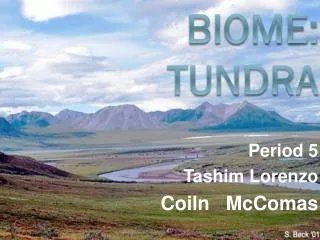
Period 5 Tashim Lorenzo Coiln McComas Biome: Tundra
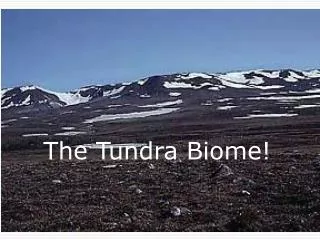
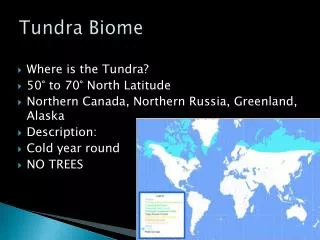
Where tundra are found Found in the northern hemisphere
A Climate Diagram • Different maps • Short growing season • Low temperature below zero degree Celsius
Major Characteristic • Has very low temperatures • Very little precipitation • Treeless • Very little nutrients • Short growing season
Major plant life Alpine Tussock grasses Dwarf trees Small leaf shrubs Heaths • Arctic • Low shrubs ,sedges , reindeer mosses ,liverworts , and grass • 400 different flowers • crustose and foliose lichen • No trees
Examples of animals ( Arctic) • Mammals: lemmings, voles, caribou, arctic hares and squirrels, arctic foxes, wolves, and polar bears • Birds :ravens, snow buntings, falcons, loons, sandpipers, terns, snow birds, and various species of gulls • Fish: cod, flatfish, salmon, and trout • Insects: mosquitoes, flies, moths, grasshoppers, black flies and arctic bumble bees
Example of animals (Alpine) • Mammals: picas, marmots, mountain goats, sheep, elk • Birds: grouse like birds • Insects: springtails, beetles, grasshoppers, butterflies
Other interesting Facts • Coldest of all biome • Its treeless • Average temperature -34 in winter • Arctic growing season 50-60 days • Alpine 180 day growing season
Reference • Greenwich Public Schools: Tundra Biome(http://www.greenwichschools.org/page.cfm?p=3631) • Knowledge Project(http://www.nature.com/scitable/content/tundra-biome-climate-diagram-13308130) • The Tundra Biome(http://www.ucmp.berkeley.edu/exhibits/biomes/tundra.php) • Google image www.google.com