
Polydactylism
E N D
Presentation Transcript
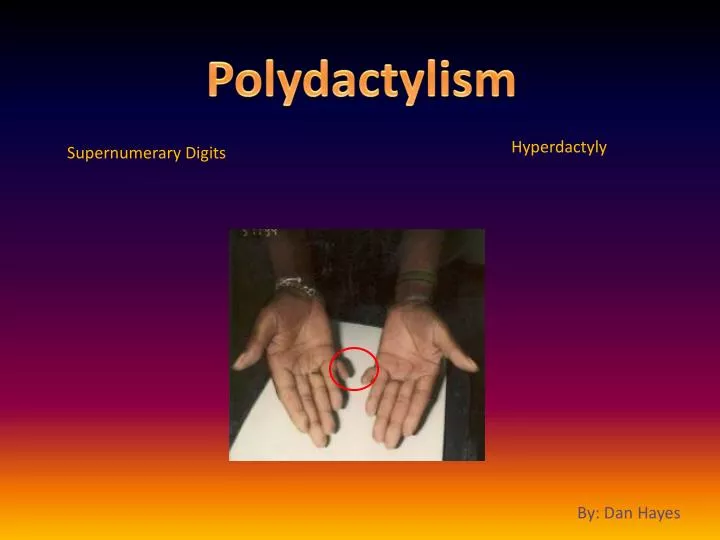
Polydactylism Hyperdactyly Supernumerary Digits By: Dan Hayes
Who can get it? • Everyone can get it • Generations of families • No specific pattern of how it started or how it is transferred. • Asian ethnicity is most common on the hand.
How to tell • Extra digit • Recognizable by visual • Hands and feet that have an extra finger or toe
How common is it? • About 1 in every 1,000 children have this disorder • One hand or foot • Most common in Asians (slide 2)
Is it fatal? • Polydactylism is not fatal • It will not shorten life and can be treated in as little as a day
Can you be tested? • There is no real test for polydactylism because it can be seen without testing • Diagnosis can be made from birth
Is there treatment? • Yes there is • Treatment can be anywhere from a single day in a hospital for surgery to a more complex treatment involving bones, ligaments and tendons.
Support Group http://www.sw.org/web/patientsAndVisitors/adam?productId=117&pid=1&gid=003176 Scott and White Healthcare in Central Texas
Interesting Facts • Very common in cats • Tyler Steven Hayden is credited with discovery • A Polydactyl can be anything from small skin tags to full fingers or toes.
Works Cited Nurmi, Deborah. "Polydactyly and Syndactyly." Encyclopedia.com. 2006. Web. <http://www.encyclopedia.com/topic/Polydactyly_and_Syndactyly.aspx>. "Polydactyly - My Child Has." Children's Hospital Boston. Web. 27 Jan. 2011. <http://www.childrenshospital.org/az/Site1073/mainpageS1073P0.html>.