
Understanding Fabric Production: Sources, Processes, and Sustainability
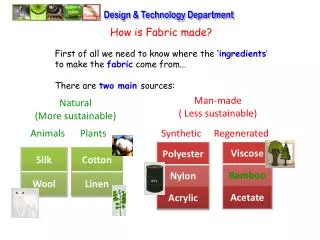
The journey of fabric production begins with its ingredients, sourced from two main categories: man-made and natural fibers. While man-made fibers tend to be less sustainable, natural fibers from animals and plants are generally more eco-friendly. These fibers are spun into yarn and can undergo various processes, including weaving, knitting, bonding, or felting. However, these methods can consume significant amounts of resources like water and chemicals, impacting both the environment and communities. Manufacturers face the challenge of producing materials sustainably with minimal ecological harm.

Understanding Fabric Production: Sources, Processes, and Sustainability
E N D
Presentation Transcript
Design & Technology Department How is Fabric made? First of all we need to know where the ‘ingredients’ to make the fabriccome from... There are two main sources: Man-made ( Less sustainable) Natural (More sustainable) Animals Plants Synthetic Regenerated
Design & Technology Department What happens to these fibres? They are spun into yarn Which are then twisted together to make them stronger Theyarnsare then... Woven Knitted or Bonded or Felted These materials can miss out the spinning process Sustainability note: All these processes use huge amounts of resources to produce e.g. Water and chemicals which all have an impact on the environment and people . Manufacturersneed to consider the best way to produce material with the minimum effect on the environment and people