Understanding the Challenges of Change: Strategies for Adjustment in Daily Life
In this lesson, we explore why some changes are difficult and how we can adjust to new situations. We will delve into concepts such as diphthongs, plot and theme in literature, and the use of adverbs that describe when and where actions take place. Through interactive online games and discussions, students will gain insights into personal adjustments—like adapting to a new school or weather—while also enhancing their vocabulary skills. Let’s engage in a fun learning experience about change and adjustment!

Understanding the Challenges of Change: Strategies for Adjustment in Daily Life
E N D
Presentation Transcript
Small Group Timer
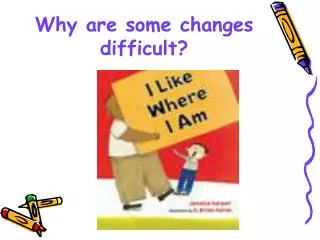
Big Question:Why are some changes difficult? • Monday • Tuesday • Wednesday • Thursday • Friday
Today we will learn about: • Amazing Words • Dipthongs: oi, oy • Plot and Theme • Summarize • Adverbs that Tell When and Where
adjust • ad – just • When you get used to a new situation, you adjust to it. • When you change or move something to make it fit or make it better, you adjust it. • The children will soon adjust to their new school. • We’ll have to adjust to the snowy weather. • Please adjust the position of the TV so we can see it.
landmark • land - mark • A landmark can be any natural or human-made feature such as a building, a statue, a bridge, or a tree that identifies a location and can serve as a guide for directions. • The Great Salt Lake is a landmark in Utah. • Fisherman’s Wharf is a landmark in San Francisco. • The Empire State Building is a New York City landmark. (next word)
unexpected • un – ex – pect - ed • Something that comes as a surprise or something you do not think will happen is unexpected. • The rainstorm was unexpected. • We had unexpected company yesterday. • The surprise party was unexpected.
Dipthongs: oi, oy • south - cow • What do you know about reading these words? • The vowels ou and ow can stand for the sound /ou/. • Today we will study vowels oi and oy and the sound they can stand for.
oil • The letters oi and oy stand for the dipthong /oi/. In a dipthong, each vowel contributes to the sound heard. • boil • coin • join • choice • noise • spoil • boy • joy • enjoy • royal • cowboy
Dipthongs: oi, oy • oil • coil • The letters oi stand for the sound /oi/ in oil and coil. • boy • The letters oy stand for the sound /oi/ in boy.
point loyal foil joy moist destroy broil spoil toy hoist voyage joint voice enjoy Dipthongs: oi, oy
Making Words a, e, i, o j, n, p, t, y
soil oyster spoil coin soy cloud boil employ scout join annoy loyal choice royal mouse Dipthongs: oi, oy
Word Family Word – guess bless chess mess dress BessTruman
Word Family Word – hand brand band land gland sand Grand Canyon stand grand strand
Theme and Plot & Summarize • Good readers pay attention to what happens in the beginning, middle, and end of a story. • They also think about the “Big idea” behind the story as they read
Theme and Plot & Summarize • Theme is the “big idea” a story is about. • Plot is what happens in the beginning, middle, and end of a story. • A summary is a short retelling of a story. • We can summarize what happens at the beginning, middle, and end of a story to help understand and remember what we read.
Daily Fix-It i wipd my hands on the cloh I wiped my hands on the cloth. the childrin yelled with joy. The children yelled with joy.
Adverbs that Tell When and Where • Adverbs tell more about a verb. • Some adverbs show when or where. • School begins tomorrow. • Tomorrow tell when. • I will be a a new student there. • There tells where.
Adverbs that Tell When and Where • I packed my books yesterday.
Adverbs that Tell When and Where • I packed my books yesterday. (when)
Adverbs that Tell When and Where • I packed my books yesterday. (when) • Now I am packing my toys.
Adverbs that Tell When and Where • I packed my books yesterday. (when) • Now I am packing my toys. (when)
Adverbs that Tell When and Where • I packed my books yesterday. (when) • Now I am packing my toys. (when) • The movers carry boxes downstairs.
Adverbs that Tell When and Where • I packed my books yesterday. (when) • Now I am packing my toys. (when) • The movers carry boxes downstairs. (where)
Adverbs that Tell When and Where • I packed my books yesterday. (when) • Now I am packing my toys. (when) • The movers carry boxes downstairs. (where) • The moving van is parked outside.
Adverbs that Tell When and Where • I packed my books yesterday. (when) • Now I am packing my toys. (when) • The movers carry boxes downstairs. (where) • The moving van is parked outside. (where)
Adverbs that Tell When and Where • I packed my books yesterday. (when) • Now I am packing my toys. (when) • The movers carry boxes downstairs. (where) • The moving van is parked outside. (where) • Soon we will go to a new house.
Adverbs that Tell When and Where • I packed my books yesterday. (when) • Now I am packing my toys. (when) • The movers carry boxes downstairs. (where) • The moving van is parked outside. (where) • Soon we will go to a new house. (when)
Wrap Up Your Day! • Vowel dipthong oi, oy • Plot and Theme • Let’s Talk About It • Tomorrow we will read about a boy who has to move.
Today we will learn about: • Amazing Words • Dipthongs: oi, oy • Vocabulary Words • High-Frequency Words • Multiple-Meaning Words • Context Clues • Adverbs that Tell When and Where