210 likes | 321 Vues
This document explores the fundamentals of while loops and do-while loops in programming. It provides clear examples, including their syntax, and compares the two structures. You will learn how to effectively implement loops for various situations, such as when the number of iterations is unknown. The guide includes a practical example involving calculating the minimum number of coins needed for a given amount of change, demonstrating user input and flowchart processes. Ideal for beginners wanting to solidify their programming knowledge in loop constructs.
E N D
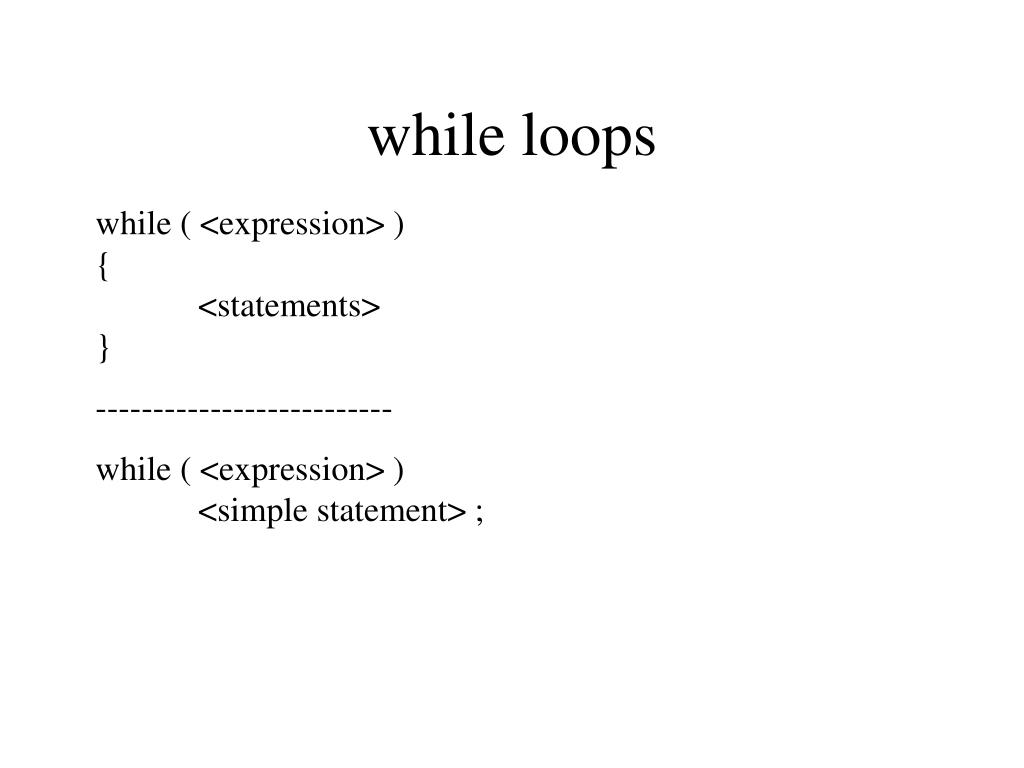
while loops while ( <expression> ){ <statements>} -------------------------- while ( <expression> ) <simple statement> ;
while loops - example x = 7;while ( x < 10 ){ printf("%d",x); x++;} OUTPUT:
while loops - example x = 7;while ( x < 3 ){ printf("%d",x); x++;} OUTPUT:
do-while loops do { statements} while ( <expression> )
do-while loops - example x = 7;do { printf("%d",x); x++;} while ( x < 10 ) OUTPUT:
do-while loops - example x = 7;do { printf("%d",x); x++;} while ( x < 3 ) OUTPUT:
comparison while vs do-while x = 7;do { printf("%d",x); x++;} while ( x < 10 ) OUTPUT: x = 7;while ( x < 10 ) { printf("%d",x); x++;} OUTPUT:
comparison while vs do-while x = 7;do { printf("%d",x); x++;} while ( x < 3 ) OUTPUT: x = 7;while ( x < 3 ) { printf("%d",x); x++;} OUTPUT:
Ideal use for while: when you don't know how many times to loop OUTPUT:
Change problem - while example Statement of problem: Given any amount of change under $2.00, determine and print out the minimum number of coins required to make that amount of change. Available coins are Halves, Quarters, Dimes, Nickels, and Pennies.
Flowcharting Process User Input Predefined Process Input/Output Preparation Display Output Decision Connector Connector (off page) Terminator
Start Flowcharting - Sample scanf amount nHalves = 0 Given some amount of money, amount, how many half dollars would be returned? myAmt = amount myAmt < 0.50 myAmt = myAmt - 0.50 nHalves = nHalves + 1 printf nHalves Finish
Expand to all coins - page 1 A Start nH = 0 scanf amount myAmt < 0.50 myAmt = amount A myAmt = myAmt - 0.50 nH = nH+ 1 B
B C nQ = 0 nN = 0 myAmt < 0.25 myAmt < 0.05 myAmt = myAmt - 0.25 myAmt = myAmt - 0.05 nQ = nQ + 1 nN = nN + 1 nD = 0 nP = 0 myAmt < 0.10 myAmt < 0.01 myAmt = myAmt - 0.10 myAmt = myAmt - 0.01 nD = nD + 1 nP = nP + 1 C D
D printf nH,nQ,nD,nN,nP Finish
Expand to all coins - page 1 A Start nH = 0; vH=0.50 scanf amount myAmt < vH myAmt = amount A myAmt = myAmt - vH nH = nH+ 1 B
B C nQ = 0; vQ=0.25 nN = 0; vN=0.05 myAmt < vQ myAmt < vN myAmt = myAmt - vQ myAmt = myAmt - vN nQ = nQ + 1 nN = nN + 1 nD = 0; vD=0.10 nP = 0; vP=0.01 myAmt < vD myAmt < vP myAmt = myAmt - vD myAmt = myAmt - vP nD = nD + 1 nP = nP + 1 C D
D printf nH,nQ,nD,nN,nP Finish
B General case: nC=number coins Output vC=value of coin Input myAmt=amt left Input/Output nQ = 0; vQ=0.25 myAmt < vQ myAmt = myAmt - vQ nQ = nQ + 1 function: change nC = 0; vC=input nD = 0; vD=0.10 myAmt < vC myAmt < vD myAmt = myAmt - vC myAmt = myAmt - vD nC = nC + 1 nD = nD + 1 return C
Start General case: nC=number coins Output vC=value of coin Input myAmt=amt left Input/Output scanf amount myAmt = amount change(nH,vH,myAmt) function:change (addr nC, val vC, addr Amt) change(nQ,vQ,myAmt) change(nD,vD,myAmt) nC = 0; vC=input myAmt < vC change(nN,vN,myAmt) change(nP,vP,myAmt) myAmt = myAmt - vC printf nH,nQ,nD,nN,nP nC = nC + 1 return Finish
Start scanf amount General case: nC=number coins Output vC=value of coin Input myAmt=amt left Input/Output myAmt = amount myAmt < 0 function:change (addr nC, val vC, addr Amt) change(nH,vH,myAmt) change(nQ,vQ,myAmt) change(nD,vD,myAmt) change(nN,vN,myAmt) change(nP,vP,myAmt) nC = 0; vC=input myAmt < vC printf nH,nQ,nD,nN,nP myAmt = myAmt - vC scanf amount nC = nC + 1 myAmt = amount return Finish