Download
1 / 26
260 likes | 394 Vues
This report investigates the effects of lithium aerosol versus non-lithium shots in plasma discharges. It details the outcomes of several discharge experiments, highlighting the differential impacts on confinement, radiated power, and density profiles. Results show that lithium aerosol injections significantly improve performance by enhancing plasma confinement and reducing radiated power, while also exhibiting notable variations in gas fueling dynamics. Data from multiple discharge shots provide insights into the effectiveness and applications of lithium in fusion research.

E N D
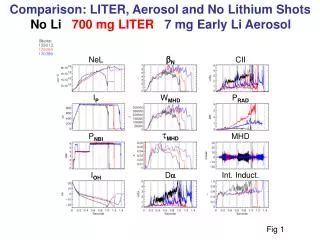
Comparison: LITER, Aerosol and No Lithium Shots No Li 700 mg LITER7 mg Early Li Aerosol bN NeL CII IP WMHD PRAD tMHD PNBI MHD IOH Da Int. Induct. Fig 1
129012 130388 130389 XP 913 Section #1 Discharges Standard Fiducial Baseline XP-913 LFS CS LFS CS Baseline XP-913 No CS Gas LFS No CS gas puff (Replaced with LFS Li Aerosol) Fig 2
XP 913 Section #1 Discharges with Li Flux Profiles Standard Fiducial Baseline XP-913 129012 130388 LFS CS gas puff LFS CS gas puff 50 mg/s 10 mg/s Li Flux Baseline XP-913 (No CS Gas) 130389 LFS Flux Profile A Max Rate 1 (from above) Li Flux Fig 3
XP 913 Section #1 Discharges with Li Flux Profiles LFS No CS gas puff Flux Profile B 50 mg/s 40 mg/s 30 mg/s 10 mg/s Li Flux Flux Profile C LFS No CS gas puff 50 mg/s 40 mg/s 30 mg/s 50 mg/s 40 mg/s 30 mg/s 10 mg/s Li Flux Fig 4
Shot 118980: A Discharge Used to Deposit Li on the CS for the Benefit of the Following Discharge t = 50 ms 150 ms 300 ms 500 ms Fig 5
Shot 118980: A Discharge Used to Deposit Li on the CS for the Benefit of the Following Discharge Three shots to find Max Rate 2 50 mg/s 30 mg/s Profile D 10 mg/s Li Flux Fig 6
2005 First LSN NBI D Shot After 25 mg of Li Pellet Injection Exhibited Factor ~50% Decrease in Density Lower single-null divertor discharges, 0.45T, D2 gas fueling 3.5mg • 25 mg of Li pumping of edge density saturated after the 3 similar D discharges and returned to pre-Li wall conditions, as expected if most injected gas reacts with the deposited Li. • Rate of density rise is below NBI fueling rate. H. Kugel M. Bell
Six Interesting Features from XP-828 • The (apparent) extreme efficacy of Li aerosol at increasing confinement • The extremely “square” Te and ne profiles seen during the NBI overdriven L-H transition • The reduced OH consumption during aerosol injection • The transient suppression of ELMs • The concomitant reduction in radiated power / Zeff • The lack of CS gas fuelling
Li Li Another Tactic for Directing Li Ions - In This Case to the Lower Divertor Example: Shot 128279
Comparison: Zeff(0) from Metals No Li 700 mg LITER7mg Early Li Aerosol Estimated Contribution of Metals to Zeff 0.6 LITER 0.4 Dimensionless 0.2 Aerosol Injection No Li 0 0 0.2 0.4 0.6 0.8 Time (sec) S. Paul
The Subtle Difference Between 130386 and 130389 130386 @ 85 ms No Li 130389 @85 ms Early Powder
Why a Double Null Discharge Would be Interesting Powder Injector Li Ions Head Preferentially for Upper Strike Points
Aerosol Injection 10 mg/s
Aerosol Injection 10 mg/s
Early Powder Injection
Early Li 2 sec shot
Getting Toward the Center Stack ( or LLD) - Early (Using a “Splash Plate”) ~ 45 Deg Inverted Spoon ~ 45 Deg Flat Plate Present Design Flat Plate LLD
Status of the Li Droppers Dropper #1: Tested and Installed on NSTX – pumping out before TIV opens (1 to 2 days) Dropper #2: Li powder degassed, vacuum housing baked out (10-8 Torr), dropper assembled but must be pumped down in the vacuum housing for 7 to 10 days without baking. Could be installed by 6/26/09 to 6/28/09 – depends on lab pump-out rate. Need to finish the XP-913 approval process
3.6 2.25 kHz 2.63 kHz 3.2 2.8 300 kHz 2.4 375 kHz 2.0 Glass Beads Flux (gm/s) 1.6 1.2 0.8 0.4 0 0 5 10 15 20 25 30 35 Applied RMS Voltage (V) Behavior of 50 mm Glass Beads in the Dropper vs Voltage and Frequency (resonance)
Li Powder Flux is Similar to Glass Bead Flux with Scaling Factor ~ 0.53 Freq : 90 Scaled Glass Bead Data 2.25 kHz (Resonant) 80 Li Powder Data 70 2.63 kHz ~ 2.5X10⁶ /s = 80 TL/s (D2) 60 300 kHz 50 Li Flux (mg/s) 40 375 kHz 30 20 10 0 0 2 4 6 8 10 12 14 Applied RMS Voltage (V)
Preparing the Li Powder for Use in NSTX (Out-gassing Residual Solvent) 25 mg Li Powder: 109 particles, 7 m2 contained in a flat pan for max out-gassing To Turbo Pump for ~ 2 weeks