Understanding Place Value: A Guide to Ones, Tens, and Hundreds
This guide explains the concept of place value in whole numbers, focusing on the importance of ones, tens, and hundreds. It illustrates how each digit's position affects its value, using clear examples like 782 and 134. Place value partitioning (P.V.P) breaks down numbers into groups for easier addition. A place value chart helps organize numbers into their respective columns. To practice, you can write numbers or have someone call out numbers, placing each digit into the correct column. Mastering place value is essential for a solid foundation in mathematics.


Understanding Place Value: A Guide to Ones, Tens, and Hundreds
E N D
Presentation Transcript
Place Value How to use place value
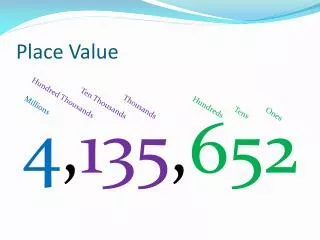
The Ones • In a whole number there is ones. • Ones are at the end of whole numbers • For example 782 the 2 is in the ones column
The Tens • In a two or higher digit number there is tens • Tens are one place to the left of the ones • For example 678 the 7 is in the tens column which makes it 70
The Hundreds • In a three or higher digit number there is hundreds • Hundreds are one place to the left of the tens and two places of the ones • For example 134 the 1 is in the hundreds column which makes it 100
Place Value partitioning • For place value partitioning or p.v.p for short you break down the numbers into groups • For example 23 + 987 = can be worked out like 23 + 7= 30 + 80 = 110 + 900 = 1010
About The Chart • The chart you just saw was a place value chart. Its split into their columns. • In between those two numbers you can put a basic fact symbol. • For example 987 + 023
How to practice • One way is to write a number on a piece of paper and put them in to columns • Or you can get someone to say a number and the get you to put each number into the columns