Download
1 / 20
200 likes | 323 Vues
This announcement covers important updates for the class, including extra copies of the directory, regrading of old quizzes upon clicker registration, and critical deadlines for unregistered clickers. Additionally, it discusses key concepts related to statistical distributions, specifically focusing on velocity distributions and height measurements of students. The session includes explanations on histograms, probability distributions, and the significance of specific and latent heats in thermodynamics, along with thought-provoking questions regarding energy transfer in phase changes.

E N D
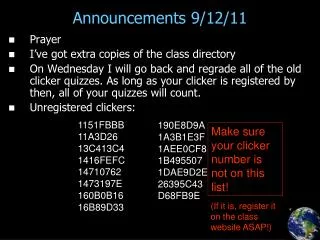
Announcements 9/12/11 • Prayer • I’ve got extra copies of the class directory • On Wednesday I will go back and regrade all of the old clicker quizzes. As long as your clicker is registered by then, all of your quizzes will count. • Unregistered clickers: • 1151FBBB • 11A3D26 • 13C413C4 • 1416FEFC • 14710762 • 1473197E • 160B0B16 • 16B89D33 • 190E8D9A • 1A3B1E3F • 1AEE0CF8 • 1B495507 • 1DAE9D2E • 26395C43 • D68FB9E Make sure your clicker number is not on this list! (If it is, register it on the class website ASAP!)
Characterizing velocities • Recall bouncing balls in jar. Focus on one type of molecule. Lots of questions, such as : • What’s the average velocity? • What’s the most popular velocity? • What’s the velocity that corresponds to the average kinetic energy? • How many molecules have velocities within a given range? How to answer: use statistical distributions, aka histograms
Height Histogram (made up data): • Total students = 49 • Round heights to closest integer, plot histogram • What is the combined area of all bars? • If I pick a student at random, what are chances he/she will be 68 inches tall? • What is the area of the bar at 68 inches divided by the total area? • How many students will be exactly 68.000000 inches tall? • If I pick a student at random, what are chances he/she will be 61.5-64.5 inches tall? • What is average height of all students? (At least, how would you figure that out?)
“Normalized” Histogram: • Total students = 49 • Y-axis now divided by total # of students. • What is combined area of all bars? • If I pick a student at random, what are chances he/she will be 61.5-64.5 inches tall? (At least, how would you figure that out?) • How many students have heights between 61.5 and 64.5 inches? • What is average height of all students?
Probability Distribution Function • Imagine total # =10 billion. Tiny “bins”. Connect peaks of curve with line… becomes a function • What is combined area of all bars? • If I pick a person at random, what are chances he/she will be 63.6-67.2 inches tall? • How many people have heights between 63.6 and 67.2 inches? • What is average height of all people? (If a non-symmetric curve, this is not just the peak of the curve.)
Velocity Distribution: “Maxwell-Boltzmann” with some constants out in front to normalize it • At 600K, how many molecules with speeds between 400 and 600 m/s? • What is “vmost probable”? • What is “vaverage”? • What is “vrms”? • How many molecules are at exactly the “most probable” velocity? Where does this eqn come from? Wait a few weeks.
Heat = not a fluid! • Sir Benjamin Thompson, Count Rumford, 1753-1814 • Boiling water with a cannon Image credit: Wikipedia
James Joule, 1818-1889 Image credit: Wikipedia
Demo/Video • Demo: Boiling water with a vacuum • Video: Boiling water in a paper cup
Reading Quiz • What name do we give to the heat capacity per unit mass? • entropy • internal energy • mass-pacity • normalized heat capacity • specific heat
Specific Heat • Q=mcDT
Thought Question • If you add 500 J of heat to a mass of water, and 500 J of heat to the same mass of copper, which one increases the most in temperature? • Water • Copper • Same
Reading Quiz • Thermal energy that is used to melt or freeze something is called: • latent heat • mass heat • melty heat • molar heat • specific heat
Water boiling Ice melting 100o C Water boils Ice warming Steam warming Water warming T 0o C Ice melts Heat energy added (Q) Phase Changes
Thought Question • If you want to melt a cube of ice that’s initially at -40C, you must first raise its temperature to 0C, and then you must melt it. Which part takes the most energy? • Raising the temperature • Melting • Same
Calorimetry • Worked problem (class designed): ____ grams of hot iron at _____ C is added to ____ g of water at _____ C in a styrofoam insulated container. What is the final temperature of the mixture? (Neglect the container.) • ciron = 448 J/kgC • cwater = 4186 J/kgC • Lwater-steam = 2.26 106 J/kg