ENERGY: Types and Transformations
Energy is the ability to perform work and is vital in various forms, including kinetic and potential energy. Kinetic energy is the energy of motion, calculated using the formula KE = ½ mv², while potential energy, such as gravitational potential energy (PE = mgh), is based on an object's position. Energy can also take other forms like thermal, electrical, and chemical energy. Learn more about these concepts through Khan Academy’s resources, which provide insights into how energy transforms and its applications in different scenarios.
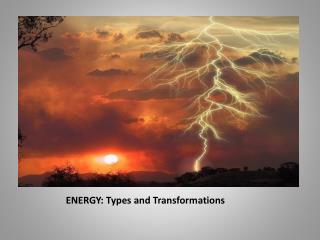

ENERGY: Types and Transformations
E N D
Presentation Transcript
Khan Academy: http://www.khanacademy.org/science/physics/work-and-energy/work-and-energy-tutorial/v/introduction-to-work-and-energy http://www.khanacademy.org/science/physics/thermodynamics/v/first-law-of-thermodynamics--internal-energy
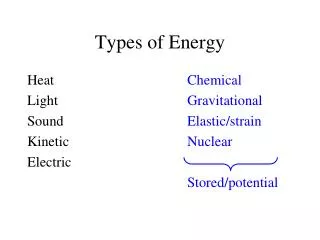
EnergyThe Ability to do Work • Two types of energy : • Kinetic • Potential • Work is a transfer of energy • Both Work and Energy are Measured in Joules
KINETIC ENERGY The energy of motion; energy of a moving object KE= ½ M x V2 M= mass V = Velocity (speed) Velocity = Distance/time V= D/T
gravitational potential energy (GPE) - energy an object contains due to its position PE = M x G x H • M = mass • G = gravitational constant 9.8m/s/s • H = Height
elastic potential energy- • energy stored in an object that is being stretched, squashed, twisted, you name it!
Chemical Potential Energy • chemical energy - energy stored in fuel (ie. food) which is released when chemical reactions take place
The table below gives examples of kinetic and potential energy .
Calculating Kinetic Energy KE = ½ m x v2 A 0.10kg bird is flying at a constant speed of 8.0 m/s. What is the bird’s Kinetic Energy? KE= ½ (0.10Kg) x (8.0 m/s)2 = 3.2 Joules = 3.2 J
Suppose a diver at the top of a 10.0meter high diving platform has a mass of 50kg. What is her Potential Energy? PE= mghPE= 50Kg x 9.8m/s/s x 10.0 mPE= 4900 J
7 Forms of energy: electrical energy- energy transferred by an electric current thermal (heat) energy - energy of an object due to its temperature. This is partly because of the random kinetic energy of the particles of the object. nuclear energy - energy stored in an atom’s nucleus light energy - energy transferred through waves and light particles (photons) sound energy - energy transferred via sound waves Mechanical energy-the sum of an object’s potential energy and kinetic energy Electromagnetic Energy- energy that travels through space in waves http://sayitwithscience.tumblr.com/post/8104049758/there-are-9-types-of-energy-chemical-energy
http://www.youtube.com/watch?v=MBRTR2dlwvA&feature=youtu.be&safe=activehttp://www.youtube.com/watch?v=MBRTR2dlwvA&feature=youtu.be&safe=active